Search engine optimization has changed significantly over the years. Techniques that once played a major role in search rankings may now have little or no direct ranking value. One topic that often creates confusion is the keyword meta tag seo approach, especially for people who still see terms such as meta keywords seo, meta name keywords seo, and seo meta keywords in website settings or SEO tools.
If you are wondering what are meta keywords in seo, the simple answer is that meta keywords were HTML metadata used to tell search engines which terms a webpage was supposedly targeting. Website owners could place a list of words into a keywords meta tag without displaying those words to visitors.
Today, major search engines do not generally use the traditional meta keywords tag as a direct ranking signal. This means that adding hundreds of hidden keywords to a page is not a reliable SEO strategy. However, understanding the history and proper use of keyword metadata can still help website owners make better decisions about on-page optimization.
This guide explains what are meta keywords, how they worked, why their importance declined, and what modern website owners should do instead.
What Are Meta Keywords in SEO?
So, what is meta keywords in practical terms?
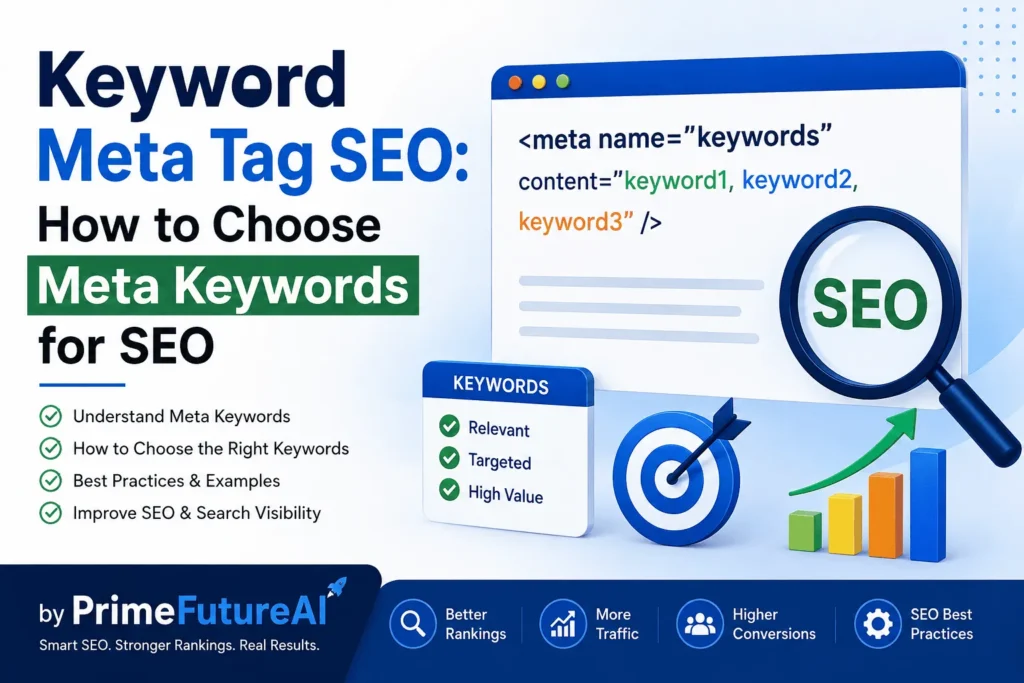
Meta keywords were words or short phrases placed inside an HTML meta tag to describe the main subject of a webpage. A simplified example looked like this:
<meta name=”keywords” content=”digital marketing, SEO services, SEO strategy”>
The purpose was to provide search engines with additional information about the page.
The phrase what is a meta keyword therefore refers to an individual term included inside this metadata field. For example, “SEO services” could be one meta keyword, while “local SEO services” could be another.
The idea sounded useful because website owners could tell search engines exactly which terms were important. Unfortunately, the system was heavily abused.
What Is SEO Meta Keywords?
The term what is seo meta keywords usually refers to the use of keyword metadata as part of an SEO strategy.
In the early days of search, website owners could place many terms into a keywords meta tag. Some marketers used relevant phrases, while others added unrelated or repeated keywords simply to attract more searches.
This eventually created a poor-quality signal. Search engines became better at analyzing the actual content, links, page structure, user intent, and other signals instead of relying on hidden keyword lists.
That is why meta keywords and seo are now very different from the way they were treated in the past.
How the Keyword Meta Tag Worked?
A traditional meta keywords tag seo implementation placed keyword phrases inside the <head> section of an HTML document.
For example:
<meta name=”keywords” content=”SEO, content marketing, technical SEO, keyword research”>
This was invisible to normal visitors.
The concept behind keywords in meta tag was simple: identify the words that represented the topic of the page. However, because the field could be manipulated easily, its usefulness declined.
A page could theoretically claim to target terms that were never mentioned in its visible content. That made the metadata unreliable.
Why Meta Keywords Lost Their SEO Value?
The biggest problem with meta keywords seo was manipulation.
Imagine a website selling running shoes. Its owner could add terms such as:
- running shoes
- sports shoes
- sneakers
- cheap shoes
- best shoes
- celebrity shoes
- fitness shoes
Some of these terms might have nothing to do with the actual page.
Search engines therefore had a strong reason to stop depending on this field.
Modern search systems can understand page topics through visible content, headings, entities, internal links, structured data, page context, and many other signals.
As a result, google seo meta keywords should not be treated as a ranking shortcut.
Google SEO Meta Keywords: What Website Owners Should Know
One of the most common questions is whether meta keywords google ranking is still possible.
Traditional keyword metadata is not something website owners should rely on for Google rankings. Adding a list of terms to a keywords meta tag does not replace high-quality content, search intent optimization, technical SEO or authoritative links.
Therefore, the idea of meta keywords google ranking should be approached carefully.
If an SEO plugin, CMS, or website builder still provides a field for keywords, that does not automatically mean search engines use it as a ranking factor.
Meta Keywords vs Modern SEO Keywords
There is an important difference between seo keywords meta and keywords used in modern SEO.
Modern SEO keywords are terms that help you understand what people search for and what information a page should address.
For example, a page about home insulation might naturally target topics such as:
- home insulation benefits
- how home insulation works
- insulation types
- energy-efficient insulation
- insulation installation
These are useful because they help shape the content.
By contrast, simply putting those phrases into a hidden seo meta keyword field does not make the page more relevant.
SEO Meta Tag Keywords Search Engine Ranking
The phrase seo optimization keywords meta tags search engine ranking can sound complicated, but the concept is straightforward.
Search engines evaluate the usefulness and relevance of a page using many signals. A hidden keyword list is not a substitute for:
- Helpful content
- Relevant headings
- Clear page structure
- Search intent
- Internal linking
- Technical performance
- Mobile usability
- Quality backlinks
- Strong page experience
Instead of focusing on meta tag keywords seo, focus on making the entire page useful for the searcher.
SEO Meta Keywords Best Practices
Even though traditional keyword metadata has little practical ranking value today, understanding seo meta keywords best practices is useful when maintaining older websites.
1. Do Not Stuff Keywords
Adding dozens or hundreds of phrases is unnecessary.
Keyword stuffing can make your optimization process messy and can encourage poor writing decisions.
2. Focus on Search Intent
Before choosing a keyword, understand why someone searches for it.
Someone searching “how to repair a leaking faucet” needs instructions, while someone searching “plumber near me” may be ready to contact a service provider.
3. Use Keywords Naturally
The main keyword should fit naturally into the title, introduction, headings, and relevant sections when appropriate.
4. Avoid Repetition
Repeating the same meta keyword or SEO phrase again and again does not make a page stronger.
5. Prioritize Useful Content
Your content should answer the reader’s question clearly instead of being written primarily for search engines.
These are better meta keywords best practices because they move attention away from outdated tricks and toward meaningful optimization.
Good Meta Keywords: What Would They Look Like?
If you are studying historical good meta keywords, imagine a webpage about organic gardening.
An old-style meta keywords example might be:
<meta name=”keywords” content=”organic gardening, vegetable garden, gardening tips, composting”>
This is a reasonable example because the terms relate directly to the page.
An example meta keywords for seo could therefore contain a small number of closely related phrases rather than an enormous list.
However, the important modern lesson is that you should not expect this metadata alone to improve rankings.
Meta Keywords Example for a Business Website
Consider a fictional local bakery.
The page focuses on custom birthday cakes. A historical site meta keywords example could have looked like:
<meta name=”keywords” content=”birthday cakes, custom cakes, celebration cakes, bakery cakes”>
These are relevant terms.
But a modern SEO strategy would use those topics throughout useful visible content. The page might explain cake options, flavors, ordering requirements, delivery information, pricing considerations, and frequently asked questions.
That creates genuine value instead of relying on hidden metadata.
Homepage Meta Keywords: Should You Add Them?
The phrase homepage meta keywords is still frequently searched by website owners.
A homepage should communicate what the business does, who it serves, and what makes it valuable. Rather than spending significant time creating a keyword list for the homepage, focus on:
- A clear title
- Strong introductory copy
- Relevant headings
- Descriptive navigation
- Useful service information
- Internal links
- Clear calls to action
- Technical SEO
The same principle applies to website meta keywords and meta keywords website fields.
How to Use Meta Keywords on Different Platforms?
People often ask how to use meta keywords in WordPress, Weebly, Shopify, and other platforms.
The exact interface differs between platforms. Some may provide metadata fields, while others may not.
For older systems that support meta name keywords, you may still encounter code such as:
<meta name=”keywords” content=”keyword one, keyword two, keyword three”>
However, adding this field should not become the center of your SEO campaign.
The question how to enter meta keywords is therefore less important than understanding which SEO elements actually influence visibility today.
What Are Meta Keywords in Weebly?
Another common question is what are meta keywords in weebly?
Historically, website builders have offered different fields for metadata and SEO information. If a platform provides a keyword field, users may assume that entering phrases there will automatically help rankings.
That assumption can be misleading.
Your priority should be optimizing the visible page content, page title, description, headings, images, URLs, internal links, and other meaningful SEO elements.
How to Find Meta Keywords on a Website?
If you want to find meta keywords website information, you can inspect the HTML source code.
Look for something similar to:
<meta name=”keywords” content=”…”>
You can also use browser developer tools or SEO auditing software to inspect a webpage.
This can be useful when reviewing an older website or auditing a competitor’s HTML.
However, finding a site meta keywords field does not mean those keywords are currently helping that website rank.
Use Meta Keyword Tag Moz and SEO Tools
People sometimes search for use meta keyword tag moz because they expect SEO platforms to recommend or analyze traditional keyword metadata.
Modern SEO tools generally provide much more useful information than a basic keyword meta tag.
An SEO audit should examine:
- Target keywords
- Search intent
- Title tags
- Meta descriptions
- Heading structure
- Content quality
- Internal links
- Broken links
- Page speed
- Indexability
- Canonical tags
- Structured data
- Backlinks
This makes keyword meta tag seo a small historical topic rather than the foundation of a modern SEO campaign.
Keywords in Meta Tags vs Keywords in Content
The phrase keywords in meta tags can refer to several different types of metadata.
Do not confuse the traditional keywords tag with important SEO elements such as:
Title Tag
The title tells search engines and users what the page is about.
Meta Description
The description summarizes the page and can influence whether a searcher chooses your result.
Heading Tags
H1, H2, and H3 headings organize the content.
Image Alt Text
Alt text describes meaningful images and supports accessibility.
Structured Data
Structured data can help search engines interpret specific information on a page.
This is why keywords vs meta tags should be understood as different concepts rather than treated as interchangeable terms.
Meta Content Keywords and Content Optimization
The term meta content keywords may refer to keywords associated with page metadata, but modern optimization should be broader.
Suppose you operate a digital marketing agency and create a page around “SEO services.”
Instead of repeatedly adding the phrase SEO services to hidden fields, build a useful page covering:
- SEO audits
- Keyword research
- Technical SEO
- On-page optimization
- Content strategy
- Link building
- Reporting
- Common SEO questions
This creates topical relevance naturally.
Real-Life Example: A Local Service Business
Imagine a fictional home cleaning company called BrightHome Cleaning.
The company wants to rank for “home cleaning services.”
A weak approach would be to create a long meta keyword examples list:
“cleaning, home cleaning, house cleaning, best cleaning, cheap cleaning, local cleaning, professional cleaning…”
A stronger approach would be to create a detailed service page explaining cleaning packages, service areas, scheduling, what customers can expect, pricing factors, and frequently asked questions.
The second approach gives visitors useful information and provides search engines with substantial context.
Real-Life Example: An Online Store
Imagine an online store selling fitness equipment.
For a page about adjustable dumbbells, the website could naturally cover:
- Adjustable dumbbell features
- Weight ranges
- Material
- Storage
- Beginner suitability
- Workout applications
- Maintenance
- Buying considerations
Instead of depending on meta keywords google or a hidden keywords metatag, the site builds relevance through useful content and clear product information.
Real-Life Example: A Marketing Agency
Suppose a marketing agency creates a page targeting “technical SEO services.”
The agency could naturally explain website audits, crawlability, indexing, structured data, page speed, mobile usability, redirects, and reporting.
The primary keyword becomes part of the page’s topic rather than simply being placed in a meta tag keywords google seo field.
This is a much more sustainable way to approach search engine optimization meta keywords concepts.
Meta Keyword Optimization: A Better Modern Approach
If you are still thinking about meta keyword optimization, redirect that effort toward keyword research and content optimization.
Start by identifying:
- What your audience searches for.
- What problem each search represents.
- What type of page should answer that search.
- What related questions users may have.
- What information competing pages fail to explain.
- Which internal pages should connect to the new page.
This approach turns keywords into a content planning tool rather than a hidden metadata list.
How PrimeFutureAI Helps Businesses Online?
PrimeFutureAI can help businesses improve their online presence by focusing on practical digital marketing and SEO strategies.
Instead of relying on outdated tactics such as stuffing a meta keywords tag seo field, a business can build a stronger search presence through keyword research, content planning, on-page SEO, technical improvements, and website optimization.
For example, a business struggling to attract organic visitors could identify valuable search topics, create dedicated service pages, improve existing content, strengthen internal linking, and monitor organic performance.
The goal is to create a website that is easy for visitors to understand and easier for search engines to interpret.
Meta Keywords SEO Best Practices Checklist
For a practical meta keywords seo best practices approach, remember these points:
- Do not depend on the traditional keywords meta tag for rankings.
- Research keywords based on real search intent.
- Create useful pages around important topics.
- Use keywords naturally.
- Write descriptive title tags.
- Create useful meta descriptions.
- Organize content with headings.
- Improve internal linking.
- Keep pages technically accessible.
- Avoid keyword stuffing.
- Review outdated metadata during SEO audits.
- Measure actual organic performance.
Final Thoughts
The history of keyword meta tag seo shows how quickly search optimization can change. Traditional seo meta keywords, meta name keywords seo, and meta tags for keywords were once discussed as important optimization techniques, but they should not be treated as a modern ranking shortcut.
If you are asking what are meta keywords, the answer is simple: they are hidden keyword metadata that was historically used to describe the topic of a webpage.
If you are asking what is meta keywords useful for today, the practical answer is that traditional keyword metadata should not be the main focus of your SEO work.
The better strategy is to use keyword research to understand your audience, create genuinely helpful content, organize your website clearly, and optimize important page elements. In other words, keywords should guide your SEO strategy rather than become a collection of hidden words.
Frequently Asked Questions
1. What are meta keywords in SEO?
Meta keywords are words or phrases historically placed in an HTML keywords meta tag to describe a webpage. They are not something modern SEO strategies should rely on for rankings.
2. Does Google use meta keywords?
Traditional google meta keywords are not a dependable Google ranking factor. Website owners should focus on useful content, search intent, technical SEO, and other meaningful optimization signals.
3. Are meta keywords still important for SEO?
Traditional seo meta keywords have little practical value for modern search rankings. Keyword research itself remains extremely important, but hidden keyword metadata is not the same thing.
4. What is a meta keyword example?
A historical example could be:
<meta name=”keywords” content=”digital marketing, SEO services, content marketing”>
These terms would describe a page about digital marketing services.
5. Should I use meta keywords on my homepage?
You generally should not spend significant SEO effort on homepage meta keywords. Focus instead on clear page messaging, relevant content, strong titles, internal links, and a good user experience.
6. What are good meta keywords?
Historically, good meta keywords were relevant and specific phrases that accurately described a page. Today, however, it is more useful to turn those phrases into topics and content opportunities.
7. How do I use meta keywords?
If your CMS still provides a traditional keyword field, you can technically enter relevant terms, but do not expect that field to improve search rankings. Use your keyword research to improve the actual page content and structure.
8. What are meta keywords in Weebly?
Meta keywords in Weebly refers to the traditional keyword metadata field that some website-building systems have supported. The presence of such a field does not mean that it is an important modern ranking signal.
9. Can meta keywords improve Google rankings?
Traditional meta keywords google ranking claims should be treated cautiously. Adding keywords to a hidden metadata field is not a substitute for strong content and comprehensive SEO.
10. What is the difference between keywords and meta tags?
Keywords are search terms associated with a topic or user query. Meta tags are HTML elements that provide information about a webpage. A keyword can be used within different page elements, while the old keywords meta tag was specifically designed to store keyword lists.
11. What are meta keywords best practices today?
The best modern practice is not to rely on the traditional keywords tag. Instead, use keyword research to understand search intent and create pages that answer users’ needs clearly and naturally.
12. Should I remove old meta keyword tags?
If an existing website contains old keyword metadata, there is usually little reason to spend major resources maintaining it. During a website cleanup or redesign, you can review outdated metadata and prioritize SEO elements that provide greater value.
13. What does meta tagging for google?
Meta tagging for google is the practice of adding specific information to a webpage’s HTML that helps search engines understand what the page is about. Common examples include the title tag and meta description.