Search is changing quickly. For years, businesses focused mainly on SEO (Search Engine Optimization) to make their websites appear higher in Google and other traditional search results. Today, people are also asking questions directly through AI-powered search and answer platforms.
This has introduced another important concept: GEO, or Generative Engine Optimization.
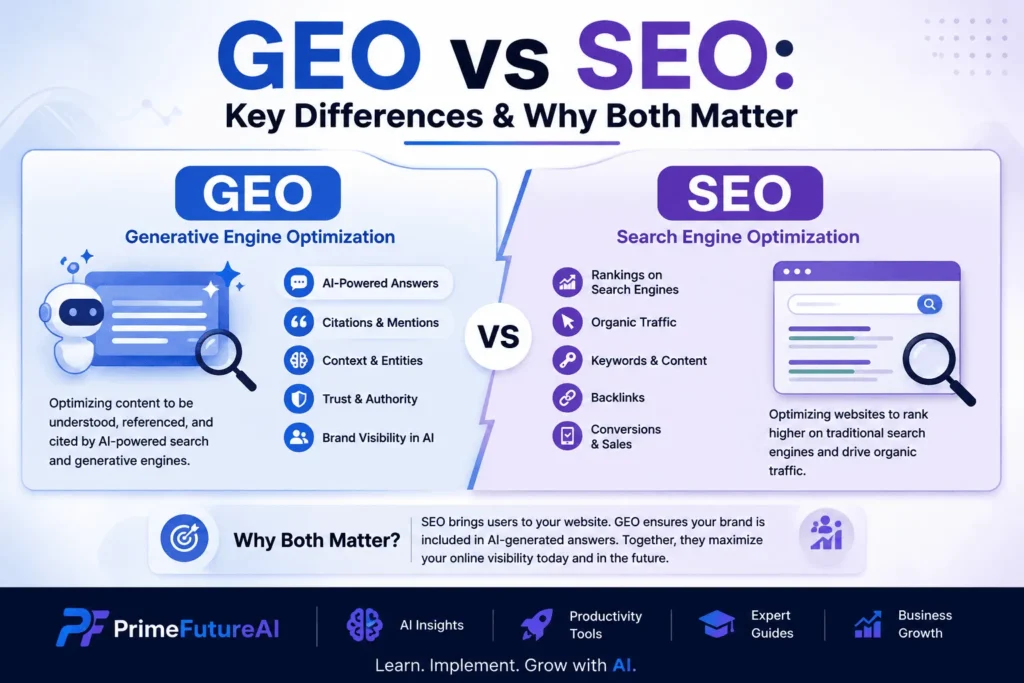
While SEO focuses on helping a website rank in traditional search results, GEO focuses on helping a brand become visible, relevant, and potentially cited in AI-generated answers. The two strategies are closely connected, but they are not exactly the same.
For businesses that want long-term online visibility, the smartest approach is not to choose between GEO vs SEO. Instead, businesses should build a strategy that supports both.
What Is SEO?
SEO stands for Search Engine Optimization.
SEO is the process of improving a website so that search engines can understand its content and potentially rank its pages for relevant searches.
For example, imagine someone searches:
“Best accounting software for small businesses”
A business selling accounting software may create a detailed page targeting this topic. Through SEO, the company can improve its chances of appearing in traditional search results.
SEO usually involves several areas, including:
- Keyword research
- Helpful content creation
- On-page optimization
- Technical SEO
- Internal linking
- Website speed
- Mobile usability
- Backlinks and authority
- Search intent
- Structured data
- Local SEO
- Conversion optimization
The main objective is simple: get discovered through search and encourage people to visit your website.
What Is GEO?
GEO stands for Generative Engine Optimization.
GEO focuses on improving a brand’s chances of being discovered, understood, mentioned, recommended, or cited when people use AI-powered search and generative answer systems.
Instead of only asking:
“How can my page rank number one?”
GEO asks:
“How can my business become a useful and trusted source when an AI system answers this question?”
AI-powered search experiences can synthesize information from multiple sources and provide users with a direct answer rather than simply displaying a list of links.
For example, a person might ask an AI search tool:
“What should I look for when choosing a digital marketing agency for a small business?”
The system may produce an answer containing several recommendations, explanations, or sources.
If your company has strong, clear, trustworthy online information, your business may have a better opportunity to become part of that information ecosystem.
GEO vs SEO: The Main Difference
The easiest way to understand the difference is this:
SEO is primarily about ranking webpages. GEO is about becoming useful to generative answer systems.
Traditional SEO often revolves around the journey:
Search query → Search results → Website click → Conversion
GEO is more closely associated with:
Question → AI retrieval → Generated answer → Brand mention/citation → Possible visit or conversion
This does not mean SEO has become unimportant. In fact, SEO remains an important foundation because AI systems still need accessible, understandable, and trustworthy information to work with.
Research and industry analysis increasingly describe GEO as a complementary discipline rather than a simple replacement for SEO.
GEO vs SEO Comparison
| Factor | SEO | GEO |
|---|---|---|
| Full form | Search Engine Optimization | Generative Engine Optimization |
| Primary focus | Search rankings | AI-generated visibility |
| Main environment | Traditional search engines | Generative AI and AI search |
| Main objective | Earn rankings and clicks | Earn mentions, citations, or inclusion |
| Content style | Search-focused and user-focused | Clear, extractable, context-rich information |
| Important signals | Relevance, technical quality, authority, links | Relevance, clarity, authority, factuality, entity context |
| Common measurement | Rankings, organic traffic, CTR, conversions | Mentions, citations, visibility, answer presence |
| Best approach | Optimize pages for search | Make information easy to understand and retrieve |
| Relationship | Foundation | Complement to SEO |
Why SEO Still Matters in the Age of GEO?
It can be tempting to think that GEO means businesses should stop doing SEO.
That would be a mistake.
A website still needs to be technically accessible. Search engines and AI systems need to understand what a business does, what it offers, who it serves, and why its information should be trusted.
A website with poor structure, confusing content, broken pages, weak internal linking, and limited authority will have difficulty building visibility anywhere.
SEO helps establish the digital foundation.
GEO builds on that foundation by making information more useful for AI-driven discovery.
Think of SEO as building and maintaining a strong digital storefront, while GEO is about making sure modern AI assistants understand what is inside that storefront and when it is relevant to recommend it.
How GEO Changes Content Strategy?
Traditional SEO content often starts with keyword research.
GEO encourages businesses to think more deeply about the questions behind those keywords.
For example, a company might target:
“best CRM software”
An SEO-focused content plan might create an article around that keyword.
A broader GEO-friendly strategy could address the entire decision-making journey:
- What is CRM software?
- Why does a small business need CRM software?
- What features should a CRM have?
- How much does CRM software cost?
- What is the difference between CRM and ERP?
- What CRM is suitable for a five-person sales team?
- What mistakes should businesses avoid when choosing CRM software?
- How long does CRM implementation take?
This approach creates a more complete information resource.
Clear definitions, direct answers, structured sections, original insights, and verifiable information can make content easier for both people and machines to understand. Current research also cautions that GEO is not a guaranteed formula; AI visibility can vary between systems, queries, languages, and repeated searches.
Real-Life Example: A Local Restaurant
Consider a restaurant called Green Bowl Kitchen.
The restaurant wants more customers.
SEO approach
The restaurant creates a page targeting:
“healthy restaurant in USA”
It improves the page title, headings, location information, menu content, internal links, and local search presence.
The goal is to appear when people search for restaurants using traditional search.
GEO approach
The restaurant also publishes useful information such as:
- What healthy meals are available?
- What vegetarian options are available?
- Does the restaurant offer high-protein meals?
- What are the restaurant’s opening hours?
- Where is the restaurant located?
- What makes its menu different?
- Which meals are suitable for office lunches?
The business also ensures that important information about its identity and services is consistent across its website and other reputable online sources.
Now, when someone asks an AI system something like:
“Where can I find healthy lunch options in USA?”
the restaurant has a stronger body of information that can potentially help an AI system understand its relevance.
This is the practical difference between merely targeting a keyword and building a comprehensive digital presence.
Real-Life Example: An E-Commerce Business
Imagine an online store selling running shoes.
With SEO, the company might create product pages targeting searches such as:
“men’s running shoes”
It can also publish guides such as:
“How to choose running shoes for beginners.”
With GEO, the company can go further.
Its content could clearly explain:
- How running shoes differ from walking shoes
- Which features matter for beginners
- How shoe cushioning works
- How to choose the right size
- When running shoes should be replaced
- Which shoes are appropriate for different running conditions
- Frequently asked questions about running footwear
The company can also provide clear product specifications and maintain consistent information about its brand.
This creates a stronger information ecosystem instead of relying on one product keyword.
Real-Life Example: A B2B Software Company
Suppose a software company sells project management software to small businesses.
Its SEO strategy might target:
- Project management software
- Project management tools for small businesses
- Team collaboration software
- Task management software
Its GEO strategy could build detailed resources answering practical questions:
“How do I choose project management software for a remote team?”
“What features does a small business actually need?”
“How much project management software does a 10-person company need?”
“What is the difference between task management and project management?”
This type of content demonstrates expertise while giving AI systems and human readers more context about the company and its subject area.
What Makes Content More GEO-Friendly?
There is no magic GEO formula that guarantees inclusion in every AI answer.
However, businesses can make their information easier to understand and evaluate.
1. Answer Questions Directly
Do not make readers search through five paragraphs to find a simple answer.
Start with the answer, then provide supporting details.
2. Use Clear Headings
Use headings that match the questions your customers actually ask.
For example:
What Does Technical SEO Include?
is usually clearer than:
Our Revolutionary Approach to Website Performance.
3. Build Topic Depth
One short article rarely establishes strong expertise.
Create related content around your major business topics and connect those pages with internal links.
4. Provide Original Information
Generic information is everywhere.
Original research, company experience, examples, statistics, case studies, expert opinions, and useful observations can make content more valuable.
5. Keep Business Information Consistent
Make sure your company name, services, contact information, locations, products, and descriptions are accurate across important online properties.
6. Improve Website Fundamentals
GEO does not eliminate technical SEO.
A website should still be crawlable, usable, mobile-friendly, logically organized, and technically sound.
7. Demonstrate Expertise
Clear authorship, useful references, real experience, accurate claims, and strong business information can help establish credibility.
GEO vs SEO Work Better Together
The biggest mistake is treating GEO vs SEO as competitors.
They are better viewed as two parts of modern online visibility.
SEO helps a business build discoverability through traditional search.
GEO helps the business prepare for an environment in which people increasingly ask questions in conversational and AI-powered interfaces.
A strong strategy might look like this:
SEO foundation → High-quality content → Topic authority → Strong business/entity information → AI-friendly structure → Continuous measurement
The goal is not to write content exclusively for machines.
The best content should first be useful to people.
When content is accurate, organized, easy to understand, and genuinely helpful, it can serve both traditional search users and AI-driven discovery.
How PrimeFutureAI Helps Businesses Online?
PrimeFutureAI can be positioned as a useful resource for businesses looking to understand and use AI-driven digital opportunities.
Its online platform focuses on AI-related guides, tools, tips, and practical information designed to make AI topics easier to understand for beginners and experienced users. Public information about the site describes its purpose as helping readers learn about AI tools and ways to improve productivity and creativity.
For businesses, an AI-focused platform such as PrimeFutureAI can support online growth in several practical ways.
AI Education
Many business owners know that AI is important but do not know where to start.
Easy-to-understand guides can help businesses learn about AI tools, automation, content workflows, productivity systems, and emerging digital trends.
Content Opportunities
Businesses can use AI research and content ideas to identify questions their customers are asking.
For example, a small business selling accounting services could develop content around:
- Small business accounting
- AI accounting tools
- Bookkeeping automation
- Business expense tracking
- Tax preparation software
- Financial organization
This can support a broader SEO vs GEO content strategy.
Productivity
AI tools can help businesses reduce repetitive work.
Depending on the business, AI may assist with brainstorming, research, content planning, customer-support workflows, data organization, summaries, and other routine activities.
The important point is that AI should support human decision-making rather than replace judgment.
Staying Current
Digital marketing changes quickly.
Businesses that continuously learn about AI search, automation, content strategy, and online marketing can make better decisions as customer behavior changes.
PrimeFutureAI can contribute to this learning process by making AI-related topics easier to understand and apply.
SEO + GEO: A Practical Strategy for Businesses
Businesses do not need two completely separate marketing departments.
Instead, they can integrate both approaches into one content strategy.
For every important topic, ask five questions:
- What are people searching for?
- What problem are they trying to solve?
- What questions might they ask next?
- Can our content provide a clear and trustworthy answer?
- Can both search engines and AI systems easily understand our information?
This approach keeps the focus on the customer rather than chasing every new marketing acronym.
Common GEO vs SEO Mistakes
Mistake 1: Keyword Stuffing
Repeating the same keyword again and again does not make content better.
Write naturally and cover the topic comprehensively.
Mistake 2: Writing Only for AI
Content that sounds robotic will often be unpleasant for human readers.
Human readability should remain a priority.
Mistake 3: Ignoring Traditional SEO
GEO is not a reason to abandon technical SEO, website structure, internal links, or search visibility.
Mistake 4: Publishing Generic AI Content
Simply generating large amounts of AI-written text does not automatically create authority.
Businesses should add experience, useful examples, original information, editing, and fact-checking.
Mistake 5: Expecting Immediate Results
SEO and GEO are long-term visibility strategies.
A business should measure progress over time rather than expecting instant results from a few optimized pages.
FAQs About GEO vs SEO
Q: Is GEO replacing SEO?
No. GEO and SEO serve different but overlapping purposes. SEO focuses primarily on traditional search visibility, while GEO focuses on visibility within generative AI experiences. A combined strategy is generally more practical than abandoning SEO.
Q: Which is better, GEO vs SEO?
Neither is universally “better.” SEO remains important for traditional organic search, while GEO is increasingly relevant as people use AI-powered search and answer tools.
Q: Does GEO mean writing content for ChatGPT?
Not exactly. GEO is broader than simply writing for one AI platform. It involves making a brand’s information understandable, relevant, authoritative, and retrievable across generative search experiences.
Q: Can small businesses benefit from GEO?
Yes. Small businesses can use GEO principles to clearly explain their expertise, services, products, locations, customer problems, and unique experiences.
Q: Does SEO help GEO?
There is considerable overlap. Technical accessibility, useful content, clear site structure, authority, and strong topical relevance can support both traditional search and AI-driven discovery. However, AI visibility is not guaranteed simply because a page ranks well.
Q: How long does GEO take to work?
There is no universal timeline. AI systems can change their retrieval and ranking behavior, and visibility can vary by platform and query. Businesses should treat GEO as an ongoing optimization and measurement process rather than a one-time task.
Q: Should businesses use AI to create SEO content?
AI can be useful for research, brainstorming, outlining, editing, and workflow automation. However, businesses should review AI-generated content carefully and add genuine expertise, accurate information, original examples, and human judgment.
Q: What is the future of SEO?
SEO is unlikely to disappear simply because AI search is growing. Instead, search marketing is expanding. Businesses now need to think about traditional rankings, AI-generated answers, brand authority, user experience, and conversions together.
Final Thoughts
The GEO vs SEO debate is not really about choosing one strategy.
It is about understanding how online discovery is evolving.
SEO helps businesses compete for visibility in traditional search results. GEO helps businesses prepare for a world where users increasingly ask AI systems for direct answers, recommendations, comparisons, and explanations.
The strongest strategy combines both.
Businesses should build technically healthy websites, publish genuinely useful content, answer customer questions clearly, demonstrate expertise, maintain consistent business information, and develop authority across their digital presence.
PrimeFutureAI can also play a role in this broader shift by helping businesses and online audiences learn about AI tools, productivity, and emerging digital practices in accessible language.
Ultimately, the winning principle is simple:
Do not optimize only for search engines. Build an online presence that is useful to people, understandable to technology, and trustworthy enough to be remembered.
That is where SEO and GEO come together.