Search engine optimization is not limited to what happens on your website. You can publish excellent content, optimize your pages, improve site speed, and target the right keywords, but your online growth can still be limited if nobody outside your website recognizes your brand.
This is where off-page SEO becomes important.
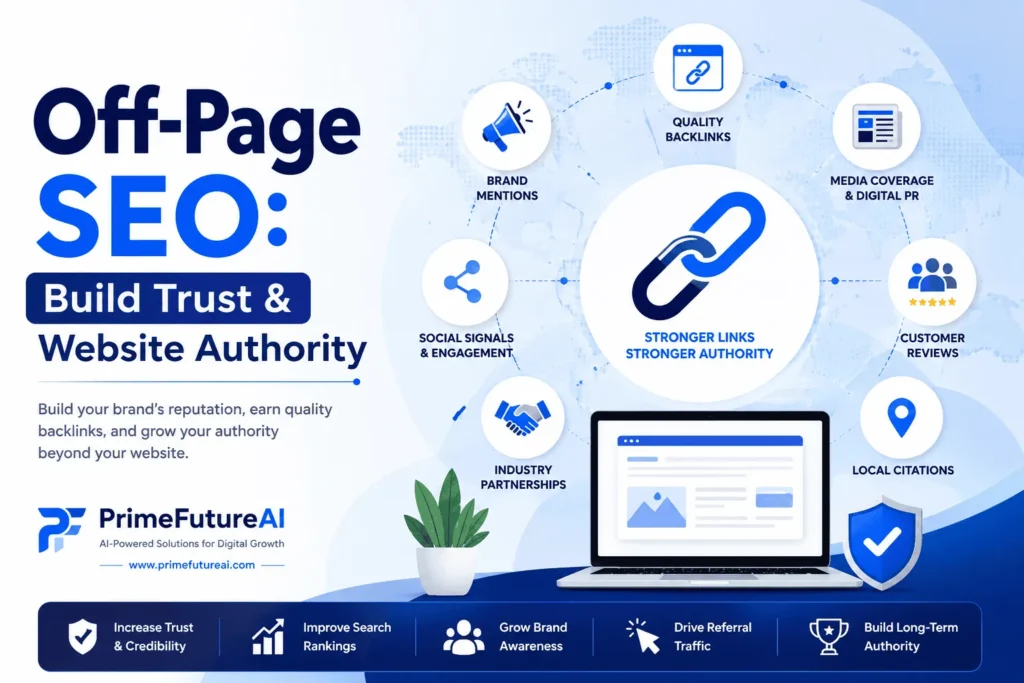
Off-page SEO is the process of building your website’s reputation, credibility, visibility, and authority through activities that happen outside your own website. It includes earning quality backlinks, getting mentioned by relevant websites, building a recognizable brand, collecting genuine reviews, developing digital PR opportunities, participating in industry communities, and creating relationships that naturally lead people back to your business.
The simple idea is this: on-page SEO tells search engines what your business says about itself, while off-page SEO helps demonstrate what other people and websites say about your business.
Google explains that links help it discover pages and understand relationships across the web, while its broader SEO guidance emphasizes useful, reliable, people-first content rather than shortcuts designed only to manipulate rankings.
What Is Off-Page SEO?
Off-page SEO refers to SEO activities performed outside your website that can contribute to your website’s visibility, reputation, and authority.
The most familiar example is link building. When another relevant website links to one of your pages, it creates a connection between the two websites. However, modern off-page SEO is much broader than simply collecting backlinks.
A strong off-page SEO strategy can involve:
- Earning backlinks from relevant websites
- Digital PR and media coverage
- Brand mentions
- Business and industry citations
- Genuine customer reviews
- Local SEO signals
- Expert interviews
- Industry partnerships
- Guest contributions
- Useful content that people naturally reference
- Social media visibility and community participation
- Building relationships with publishers, creators, and organizations
The goal should not be to create hundreds of links as quickly as possible. The goal is to create real reasons for other people to mention, recommend, reference, or link to your business.
Why Does Off-Page SEO Matter?
Imagine two businesses selling similar products.
Business A has a beautiful website but almost nobody outside the company talks about it.
Business B has a strong website, industry publications mention it, customers leave authentic reviews, partners recommend it, and relevant websites reference its research.
Which business appears more established?
Business B has something valuable that cannot be created entirely through website optimization: external credibility.
Search engines use many signals to determine relevance and prominence. Google also notes that PageRank is based on links but is only one part of a much larger search system.
That means off-page SEO should not be treated as a magic ranking trick. Instead, it should be viewed as a long-term process for making your business more discoverable and trusted across the internet.
Off-Page SEO vs. On-Page SEO
Understanding the difference between on-page and off-page SEO makes the concept easier.
On-Page SEO
On-page SEO focuses on elements you control directly on your website.
Examples include:
- Page titles
- Headings
- Keyword usage
- Content quality
- Internal linking
- Images and image descriptions
- URLs
- Meta descriptions
- Product or service pages
- Content structure
Off-Page SEO
Off-page SEO focuses on external signals and relationships.
Examples include:
- Backlinks
- Brand mentions
- Online reviews
- Digital PR
- Industry citations
- Partnerships
- Third-party recommendations
- External publications
Think of it this way:
On-page SEO is your business introducing itself. Off-page SEO is other people confirming that your business deserves attention.
Both work together.
Key Off-Page SEO Strategies
1. Earn High-Quality Backlinks
Backlinks are links from another website to your website.
They can help users discover your content and can contribute to how search engines understand your site’s place within the broader web. Google specifically identifies links as an important way its systems discover pages.
But quality matters more than simply chasing a large number.
For example, suppose you operate a cybersecurity company.
One backlink from a respected technology publication discussing your original cybersecurity research may be far more valuable strategically than dozens of unrelated links from low-quality websites.
Good backlink opportunities can come from:
- Industry publications
- Relevant blogs
- Professional organizations
- Universities and research resources
- Business partners
- News websites
- Local organizations
- Useful resource pages
The best links usually happen because you have something worth referencing.
2. Create Content People Want to Reference
One of the strongest approaches to off-page SEO is creating content that naturally attracts attention.
Instead of asking, “How can I get 100 backlinks?”
Ask:
“What could I publish that another website would genuinely want to reference?”
Possible examples include:
- Original research
- Industry surveys
- Statistics
- Detailed guides
- Free calculators
- Templates
- Original case studies
- Expert interviews
- Data visualizations
- Unique industry insights
For example, a digital marketing company could survey 500 small businesses about their online marketing challenges. If the findings are useful, bloggers, journalists, consultants, and other companies may reference the research.
That creates an opportunity for natural backlinks and brand recognition.
3. Use Digital PR to Build Authority
Digital PR combines public relations with online visibility.
Instead of only publishing content on your own website, you give journalists, publications, bloggers, and industry communities a reason to discuss your business.
A software company might release research about productivity trends.
A local restaurant could partner with a charity and receive coverage from local publications.
A technology consultant could provide expert commentary about a new industry development.
These activities can generate more than links. They can create brand awareness, credibility, referral traffic, and relationships.
4. Build Brand Mentions
Not every important off-page signal has to be a clickable link.
People may mention your:
- Company name
- Product
- Founder
- Service
- Research
- Campaign
- Expert
- Brand slogan
For example, suppose several industry websites discuss a new AI tool developed by your company. Even when every mention does not contain a backlink, your brand is becoming part of the conversation.
This is why successful off-page SEO should focus on brand building, not just link counting.
5. Encourage Genuine Customer Reviews
Reviews are particularly important for businesses serving local customers.
Consider someone searching for:
“best accounting firm near me.”
They may compare several businesses based on visibility, reputation, reviews, services, and perceived credibility.
A company with consistent genuine feedback can make a stronger first impression than one with little online reputation.
Businesses should encourage satisfied customers to leave honest reviews and respond professionally to both positive and negative feedback.
Never manufacture reviews simply to make your business appear better. Authenticity matters.
6. Strengthen Local Citations
Local businesses can also benefit from consistent information across relevant directories and business platforms.
Important details include:
- Business name
- Address
- Phone number
- Website
- Business category
- Opening hours
For example, imagine a dental clinic listed under three different addresses across different platforms. Customers may become confused, and the business can appear less reliable.
Consistent information helps create a clearer digital footprint.
7. Develop Industry Relationships
SEO is partly technical, but authority is also relational.
Build relationships with:
- Industry experts
- Complementary businesses
- Journalists
- Bloggers
- Podcast hosts
- Professional associations
- Event organizers
- Local organizations
- Content creators
These relationships can create opportunities for interviews, collaborations, partnerships, events, expert commentary, and content references.
The important word is relationship.
Do not approach every website owner with the same “Please give me a backlink” message.
Offer something useful first.
Real-Life Examples of Off-Page SEO
Example 1: A Local Bakery
Imagine a bakery called “Fresh Oven” in a competitive city.
Instead of only publishing product pages, the bakery starts collaborating with local food bloggers, sponsoring a community event, participating in a charity food drive, and creating a guide about popular regional desserts.
A local newspaper covers the charity event.
A food blogger writes about the bakery.
A community organization lists the bakery as a sponsor.
A local lifestyle website references the dessert guide.
Fresh Oven has now built multiple external connections.
The SEO benefit is only one part of the result. The bakery may also receive new customers through referrals and increased brand recognition.
Example 2: A SaaS Company
Consider a project management software company competing against established brands.
Instead of trying to acquire random backlinks, the company publishes an original survey about remote-work productivity.
The company then shares its findings with business publications and industry newsletters.
Several publications discuss the results.
A podcast invites the company’s founder to discuss the research.
Other blogs reference the statistics.
The company has created an authority loop:
Original research → media attention → brand mentions → referral traffic → relationships → additional opportunities.
That is much more sustainable than simply buying links.
Example 3: A Small E-Commerce Business
Imagine an online business selling environmentally friendly home products.
The company collaborates with sustainability bloggers and creates a detailed guide explaining how customers can reduce household waste.
A sustainability website references the guide.
A creator shares it with an audience.
Customers discover the business through those external sources.
The company gains visibility without depending entirely on paid advertising.
What Off-Page SEO Tactics Should You Avoid?
Not every SEO shortcut is a good strategy.
Avoid practices such as:
- Buying large quantities of low-quality backlinks
- Using irrelevant link networks
- Spamming blog comments
- Creating fake reviews
- Using automated link-building spam
- Manipulating websites purely for links
- Publishing hundreds of low-value guest posts solely for backlinks
- Paying for links without appropriate disclosure or qualification
Google provides specific guidance for qualifying sponsored, user-generated, and nofollow links. Paid placements, for example, should be appropriately marked with sponsored or another suitable qualification.
The principle is simple:
Do not try to manufacture authority. Build something that deserves authority.
How to Measure Off-Page SEO Success?
Off-page SEO should be measured using multiple indicators rather than one number.
Track:
Backlink Quality
Look at whether new links come from relevant, legitimate websites.
Referring Domains
Monitor how many unique websites are sending visitors or linking to your business.
Brand Mentions
Track how often your company is being discussed online.
Referral Traffic
Check whether external websites are actually sending potential customers.
Organic Visibility
Monitor changes in rankings and search impressions for important topics.
Leads and Sales
Ultimately, visibility should support business outcomes.
A website gaining hundreds of irrelevant links but no customers is not necessarily succeeding.
A smaller company earning a few highly relevant mentions that generate qualified leads may be achieving far more.
How PrimeFutureAI Helps Businesses Online?
PrimeFutureAI can help businesses approach online growth by combining practical AI-focused guidance with digital strategy.
For businesses trying to become more visible online, AI can help accelerate many activities surrounding content and marketing.
PrimeFutureAI can be positioned as a useful resource for businesses that want to:
- Discover content ideas
- Improve marketing productivity
- Research topics and audiences
- Develop content strategies
- Generate initial content concepts
- Organize digital marketing workflows
- Explore AI tools for business productivity
- Support social media planning
- Identify opportunities for improving online presence
The most important point is that AI should support strategy rather than replace it.
For example, a business could use AI to brainstorm ten potential research topics. Its marketing team could then select one, conduct genuine research, turn the findings into a valuable report, and promote that report through industry outreach.
The AI helps accelerate the workflow, while the business provides the expertise, data, experience, and originality.
That combination can create stronger marketing assets that have a better chance of earning attention beyond the company’s own website.
A Simple Off-Page SEO Plan for Beginners
If you are starting from zero, do not try everything at once.
Follow a simple progression.
Step 1: Make Your Website Worth Mentioning
Create useful pages, resources, guides, case studies, and original content.
Step 2: Identify Your Industry Community
Find relevant publications, organizations, creators, partners, and websites.
Step 3: Create One Strong Linkable Asset
Publish something genuinely useful, such as original research, a detailed guide, or a practical tool.
Step 4: Start Outreach
Contact relevant people who could genuinely benefit from the resource.
Step 5: Build Relationships
Do not make every interaction about backlinks.
Step 6: Encourage Real Reviews
Ask genuine customers for honest feedback.
Step 7: Track Results
Measure links, mentions, referral traffic, organic visibility, leads, and conversions.
Step 8: Repeat What Works
Over time, identify which content and outreach activities generate the strongest business results.
Why Quality Beats Quantity in Off-Page SEO?
A common mistake is believing that SEO success comes from collecting as many backlinks as possible.
Imagine receiving 1,000 links from unrelated, low-value websites.
Now compare that with receiving 10 relevant links from respected websites in your industry.
The second scenario may be far more meaningful.
Off-page SEO is not a competition to see who can accumulate the biggest backlink number.
It is about building a credible digital reputation.
Think of backlinks, mentions, reviews, partnerships, and media coverage as pieces of a larger reputation puzzle.
The stronger and more relevant those pieces are, the clearer your business identity becomes across the web.
FAQs About Off-Page SEO
Q: What is off-page SEO in simple words?
Off-page SEO means improving your website’s reputation and visibility through activities that happen outside your own website. Backlinks, brand mentions, reviews, digital PR, citations, and industry relationships are common examples.
Q: Are backlinks still important for SEO?
Yes, links remain an important part of how search engines discover and understand pages. However, SEO involves many signals, so backlinks should not be treated as the only measure of success.
Q: How many backlinks do I need?
There is no universal number. Ten highly relevant links can potentially be more useful than hundreds of irrelevant links. Focus on relevance, quality, credibility, and the value of the referring website.
Q: Can social media improve off-page SEO?
Social media can increase content exposure, brand awareness, conversations, and referral traffic. Social activity should be viewed as part of a broader digital presence rather than a guaranteed direct ranking mechanism.
Q: How long does off-page SEO take to work?
Off-page SEO usually requires patience. New relationships, mentions, backlinks, and reputation develop over time. Google notes that SEO changes can take anywhere from relatively short periods to several months to become reflected in search performance, depending on the situation.
Q: Is buying backlinks a good SEO strategy?
Buying links purely to manipulate search rankings can create significant risk and is not a sustainable approach. Businesses should prioritize earning legitimate mentions and links through useful content, relationships, PR, partnerships, and expertise.
Q: What is the difference between link building and off-page SEO?
Link building is one part of off-page SEO. Off-page SEO is broader and can include brand mentions, reviews, digital PR, citations, partnerships, and other activities that build a company’s reputation outside its website.
Q: Can small businesses benefit from off-page SEO?
Absolutely. Local partnerships, community involvement, customer reviews, industry relationships, useful resources, and local media coverage can all help smaller businesses develop a stronger online presence.
Final Thoughts
Off-page SEO is ultimately about earning trust beyond your own website.
A company can tell the world that it is experienced, reliable, and knowledgeable. But when respected websites reference its work, customers leave genuine reviews, industry professionals discuss its expertise, and communities recognize its contribution, that reputation becomes much more convincing.
The best off-page SEO strategy is therefore not “get more links.”
It is:
Create value → build relationships → earn recognition → strengthen reputation → grow visibility.
For businesses using AI as part of their marketing workflow, platforms such as PrimeFutureAI can help make research, content planning, idea generation, and digital productivity more efficient. But the strongest results still come when AI-assisted workflows are combined with genuine expertise, original ideas, useful resources, and real relationships.
In a crowded online marketplace, your website is only one part of your reputation.
Off-page SEO helps build the reputation that exists everywhere else.