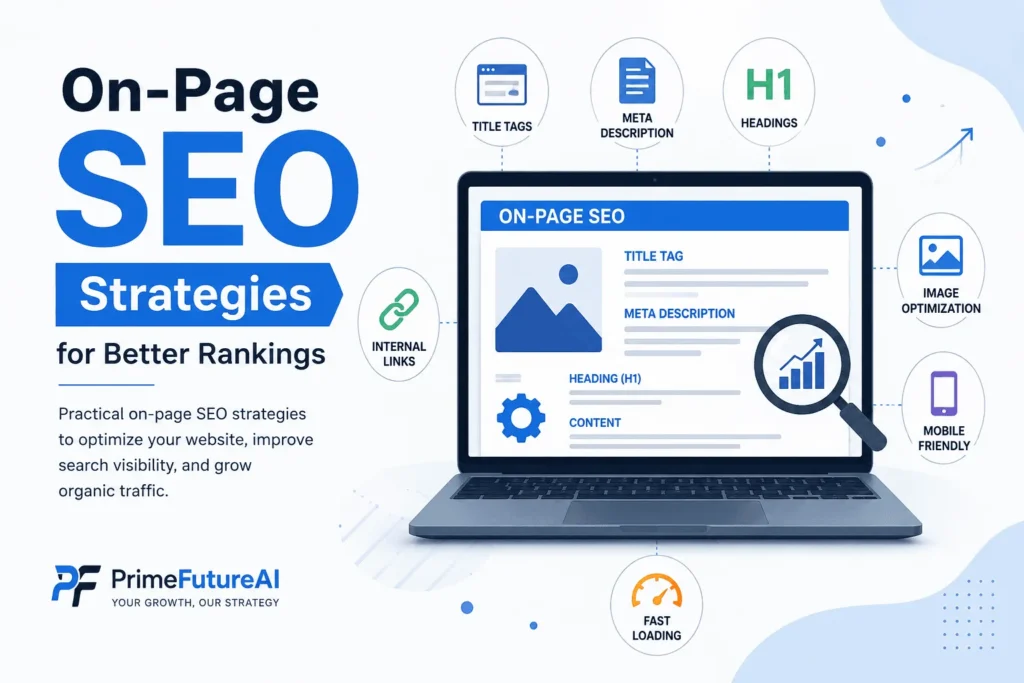
On-page SEO is one of the most important parts of a successful search engine optimization strategy. It focuses on improving the elements of your website that you can directly control, including content, headings, page titles, URLs, images, internal links, and overall page structure.
A website may have excellent backlinks, but if its individual pages are confusing, poorly structured, or unable to satisfy search intent, it can still struggle to attract organic traffic. Effective on-page SEO helps search engines understand what a page is about while making the content easier and more useful for visitors.
Google also emphasizes creating helpful, reliable, people-first content that is easy to read and well organized. It recommends using clear titles, useful headings, relevant links, descriptive content, and properly optimized images.
This guide explains practical on-page SEO strategies that businesses, bloggers, agencies, and website owners can use to improve their pages and build a stronger organic search presence.
What Is On-Page SEO?
On-page SEO refers to optimizing individual webpages to make them more understandable, useful, and relevant to both users and search engines.
It includes elements such as:
- Page titles
- Meta descriptions
- Headings
- Keywords
- Content quality
- Search intent
- URL structure
- Internal linking
- Image optimization
- Content readability
- Structured data where appropriate
- Mobile-friendly page presentation
- Clear page organization
Unlike off-page SEO, which focuses heavily on external signals such as backlinks, on-page SEO takes place directly on your website.
The goal is not to fill a page with keywords. Instead, the goal is to clearly communicate the topic and provide the information a visitor actually needs.
Why Is On-Page SEO Important?
Search engines need to understand the subject, purpose, and usefulness of a webpage before deciding where it may appear for relevant searches.
Good on-page optimization can help by:
Improving Content Understanding
Clear titles, headings, paragraphs, links, and supporting information make it easier for search engines to interpret a page.
Improving User Experience
Visitors are more likely to stay engaged when information is organized logically and answers their questions without unnecessary difficulty.
Supporting Better Search Visibility
Relevant page-level signals can help search engines connect your content with appropriate queries. However, there is no single optimization that guarantees a first-place ranking. Google itself notes that SEO improvements do not guarantee particular search positions.
Increasing Potential Clicks
A useful title and compelling search snippet can make your result more attractive when it appears in search results.
Start With Search Intent
Before writing or optimizing a page, understand why someone is searching for the topic.
For example, a person searching for “best SEO tools” may want comparisons and recommendations. Someone searching for “what is on-page SEO” is probably looking for an explanation. A person searching for “SEO agency for small business” may be closer to making a purchasing decision.
These are different types of search intent.
Common search intent categories include:
- Informational: The user wants to learn something.
- Commercial: The user is researching products or services.
- Transactional: The user is ready to take an action or purchase something.
- Navigational: The user wants to find a particular website or brand.
Your content should match the reason behind the search rather than simply repeating the target keyword.
Choose One Primary Keyword
Every important page should have a clear main topic.
For example, if your target keyword is “on-page SEO tips,” the page should consistently focus on helping readers understand and implement on-page SEO.
You can also include closely related terms such as:
- on-page SEO techniques
- SEO page optimization
- website SEO tips
- content optimization
- on-page SEO checklist
Avoid forcing keywords into every paragraph. Modern search systems can understand related language and concepts, so natural writing is generally more useful than repetitive keyword placement. Google specifically advises against keyword stuffing.
Create a Strong SEO Title
The title tag is one of the first things users may see in search results.
A good SEO title should:
- Clearly describe the page
- Match the searcher’s expectations
- Include the main topic naturally
- Be unique
- Avoid unnecessary repetition
- Encourage the right audience to click
For example:
Weak:
SEO Tips
Better:
On-Page SEO Tips: A Complete Guide to Better Rankings
Google recommends descriptive, concise, unique titles and warns against keyword stuffing and repetitive boilerplate titles.
There is no need to obsess over an exact character limit. Google can truncate title links depending on the available display space, so clarity should come before rigid length rules.
Write a Useful Meta Description
A meta description provides a short summary of a page and may influence how its search snippet is presented.
A useful description should tell users:
- What the page covers
- What they can learn
- Why the content is worth opening
For example:
Meta Description:
“Discover practical on-page SEO tips for optimizing content, titles, headings, images, URLs, and internal links to improve your website’s search visibility.”
Google notes that snippets can come from page content and sometimes from the meta description, so your visible content should also clearly communicate the page’s value.
Use a Clear Heading Structure
Headings make long content easier to scan.
Use:
- H1 for the main page topic
- H2 for major sections
- H3 for supporting points
- H4 when additional organization is genuinely necessary
For example:
H1: On-Page SEO Tips
H2: What Is On-Page SEO?
H2: Why On-Page SEO Matters
H2: Important On-Page SEO Techniques
H3: Optimize Your Page Title
H3: Improve Internal Linking
A logical heading structure helps readers move through an article. Google also recommends breaking content into sections and using headings to help users navigate pages.
Create Helpful, Original Content
Content is at the center of on-page SEO.
A page should provide genuine value instead of being created only to target search engines. Strong content should answer the main question, address related concerns, provide practical information, and avoid unnecessary filler.
Try to make your content:
- Original
- Accurate
- Easy to understand
- Relevant to the audience
- Well organized
- Updated when information changes
- Focused on solving a real problem
Google’s SEO guidance specifically encourages unique, useful, well-written, people-first content rather than simply reworking material already available elsewhere.
Keep Your Writing Easy to Read
Good SEO content does not need complicated vocabulary.
Use:
- Short paragraphs
- Clear sentences
- Descriptive subheadings
- Bullet points
- Examples
- Simple explanations
- Natural transitions
For example, instead of writing:
“The implementation of comprehensive optimization methodologies facilitates enhanced discoverability across organic search environments.”
You could write:
“A well-optimized page can be easier for search engines and visitors to understand.”
The second version is simpler and more useful.
Optimize Your URLs
A clean URL can help users understand what a page is about before opening it.
For example:
Poor URL:
primefutureai.com/page?id=8293
Better URL:
primefutureai.com/on-page-seo-tips/
Keep URLs:
- Short where practical
- Descriptive
- Relevant to the page
- Easy to read
- Free from unnecessary parameters when they are not needed
Avoid changing established URLs unnecessarily, especially on pages that already receive traffic or backlinks.
Improve Internal Linking
Internal links connect one page on your website to another relevant page.
For example, an article about on-page SEO could naturally link to pages about:
- Technical SEO
- Keyword research
- Content marketing
- SEO audits
- Link building
Internal links can help visitors discover related information and help search engines understand relationships between pages. Google recommends using meaningful anchor text and ensuring important pages can be discovered through links.
Instead of:
Click here
Use descriptive anchor text such as:
learn more about technical SEO
The anchor text gives readers a better idea of what they will find after clicking.
Optimize Images
Images can improve both the appearance and usefulness of a page.
However, large or poorly implemented images can create unnecessary problems.
Consider:
- Using relevant images
- Compressing large files
- Choosing appropriate formats
- Giving images descriptive filenames
- Writing useful alt text
- Placing images close to relevant content
For example:
Poor filename:
IMG12345.jpg
Better filename:
on-page-seo-checklist.jpg
Alt text should describe the image when appropriate. Do not use alt text as an opportunity to stuff keywords.
Google recommends placing high-quality images near relevant text and making them understandable to both users and search engines.
Make Content Mobile-Friendly
A large percentage of web browsing happens on mobile devices.
Your pages should therefore be comfortable to use on smaller screens.
Check that:
- Text is easy to read
- Buttons are easy to tap
- Images do not overflow
- Navigation works properly
- Pop-ups do not unnecessarily block content
- Important information appears clearly
A technically responsive website is only part of the equation. The actual content should also remain easy to consume on mobile.
Improve Page Experience
Visitors should be able to access and understand your content without unnecessary obstacles.
Look for problems such as:
- Slow-loading pages
- Intrusive pop-ups
- Broken links
- Difficult navigation
- Excessive advertisements
- Poor formatting
- Layout problems
Google advises site owners to avoid distracting advertisements or interstitial experiences that make it difficult for users to access the expected content.
Add Relevant Structured Data
Structured data provides search engines with additional information about certain types of content.
Depending on the page, structured data may be appropriate for things such as:
- Articles
- Products
- Events
- Organizations
- Local businesses
- Breadcrumbs
- FAQs where applicable
Structured data should accurately describe the content on the page. It should not be added simply because you want a particular search appearance.
Update Old Content
Publishing new articles is not the only way to improve a website.
Older pages may become outdated because:
- Statistics change
- Products disappear
- Tools change
- Search intent evolves
- Links become broken
- Better information becomes available
Review important pages periodically.
Update information where necessary, remove outdated claims, improve weak sections, and add useful information that genuinely improves the page.
Google’s SEO guidance also recommends reviewing previously published content and updating it when needed.
Avoid Keyword Stuffing
One of the most common on-page SEO mistakes is using the same keyword excessively.
For example, a page about SEO services does not need to say:
“Our SEO services are the best SEO services because our SEO services provide SEO services for businesses.”
This sounds unnatural and provides a poor reading experience.
Instead, explain the service naturally using related concepts, examples, benefits, and relevant terminology.
The purpose of keywords is to communicate relevance—not to make every sentence sound robotic.
Real-Life Example: Local Service Business
Imagine a small digital marketing company has a page targeting “SEO services for small businesses.”
The original page contains:
- A vague title
- Only 300 words
- No clear headings
- No internal links
- Generic service descriptions
- Large unoptimized images
- No clear explanation of the company’s process
The business could improve the page by creating a descriptive title, adding useful sections about small-business SEO challenges, explaining its process, adding relevant internal links, optimizing images, improving the page’s readability, and answering common customer questions.
The result is not guaranteed to reach the first position, but the page becomes much clearer and more useful.
Real-Life Example: E-Commerce Website
Consider an online store selling running shoes.
A product page titled:
“Shoes | Store Name”
does not tell users much.
A more descriptive title could explain the actual product and its key characteristics.
The product description can then answer practical questions such as:
- Who is the shoe designed for?
- What type of running is it suitable for?
- What materials are used?
- What sizes are available?
- How should it be maintained?
Relevant internal links can connect the product to running shoe categories, size guides, or related products.
This creates a more useful shopping experience while giving search engines clearer information about the page.
Common On-Page SEO Mistakes to Avoid
Even experienced website owners can overlook simple issues.
Some common mistakes include:
Using the Same Title on Multiple Pages
Every important page should have a title that accurately represents its specific content.
Writing for Search Engines Instead of People
If content feels unnatural because keywords were inserted everywhere, visitors may leave quickly.
Ignoring Search Intent
A page cannot effectively satisfy a query if it provides the wrong type of information.
Creating Thin Pages
Short content is not automatically bad, but pages that fail to answer the user’s actual question may offer little value.
Forgetting Internal Links
Important pages should not become isolated from the rest of the website.
Using Generic Anchor Text
Descriptive anchor text can provide more context than phrases such as “read more.”
Neglecting Older Content
Some pages can become less useful simply because nobody has reviewed them for a long time.
How PrimeFutureAI Helps Businesses Online
PrimeFutureAI helps businesses build a stronger online presence through SEO and digital marketing strategies.
For businesses that struggle with search visibility, the focus should not be limited to publishing more articles. A complete approach can involve keyword research, on-page optimization, content planning, technical SEO improvements, internal linking, website analysis, and broader digital marketing activities.
PrimeFutureAI can help businesses identify areas where their websites need improvement and develop an SEO approach around their goals and target audience. Its role can be especially useful for businesses that want to turn their website into a more organized, search-friendly, and user-focused digital asset.
For example, a business with good services but weak organic visibility may need more than backlinks. Its service pages may require better titles, stronger content, clearer calls to action, improved internal linking, and better keyword targeting. An SEO-focused strategy can bring these elements together instead of treating each page as an isolated project.
Simple On-Page SEO Checklist
Before publishing an important page, review the following:
- Choose a clear primary topic.
- Understand the search intent.
- Write a unique SEO title.
- Create a useful meta description.
- Use a clear H1.
- Organize supporting sections with H2 and H3 headings.
- Include relevant keywords naturally.
- Answer the user’s main question.
- Add useful supporting information.
- Keep paragraphs easy to read.
- Use descriptive URLs.
- Add relevant internal links.
- Optimize images and alt text.
- Check the mobile experience.
- Fix broken links.
- Review page speed and usability.
- Add appropriate structured data where relevant.
- Update outdated information.
- Remove unnecessary keyword repetition.
- Review the page from the visitor’s perspective.
FAQs About On-Page SEO
Q: What is on-page SEO?
On-page SEO is the process of improving individual website pages so that users and search engines can better understand their content, purpose, and relevance.
Q: How does on-page SEO improve rankings?
It can help search engines understand your pages and can improve how useful and relevant those pages are for visitors. However, rankings depend on many factors, so no single on-page technique guarantees a specific position.
Q: Is keyword density important for SEO?
There is no magic keyword-density percentage that guarantees rankings. Focus on natural language, topic coverage, relevance, and satisfying the user’s search intent.
Q: How many keywords should I use on one page?
There is no universal number. Start with one primary topic and naturally cover related questions and concepts that are useful to the reader.
Q: Are internal links important?
Yes. Internal links help visitors navigate between related pages and can help search engines discover and understand important content on your website.
Q: Should every page have a meta description?
Important indexable pages should generally have useful, page-specific metadata, but Google may generate a search snippet from the page’s visible content instead of using the supplied meta description.
Q: Does longer content always rank better?
No. A 3,000-word article is not automatically better than a 1,000-word article. The better page is usually the one that addresses the searcher’s needs clearly and completely without unnecessary filler.
Q: How long does it take for on-page SEO changes to work?
There is no fixed timeframe. Google explains that some changes can be reflected within hours while others may take weeks or months. It is usually better to monitor performance over several weeks rather than expecting instant results.
Final Thoughts
On-page SEO is not about finding one secret trick that instantly pushes a website to the top of Google. It is a continuous process of making individual pages clearer, more useful, better organized, and more relevant to the people searching for them.
Start with search intent, create genuinely useful content, write clear titles and headings, optimize URLs and images, build meaningful internal links, and regularly review older pages. Most importantly, avoid treating SEO as keyword placement alone.
When on-page SEO is combined with technical SEO, quality content, strong site architecture, and appropriate off-page promotion, it can become an important part of a long-term organic growth strategy.