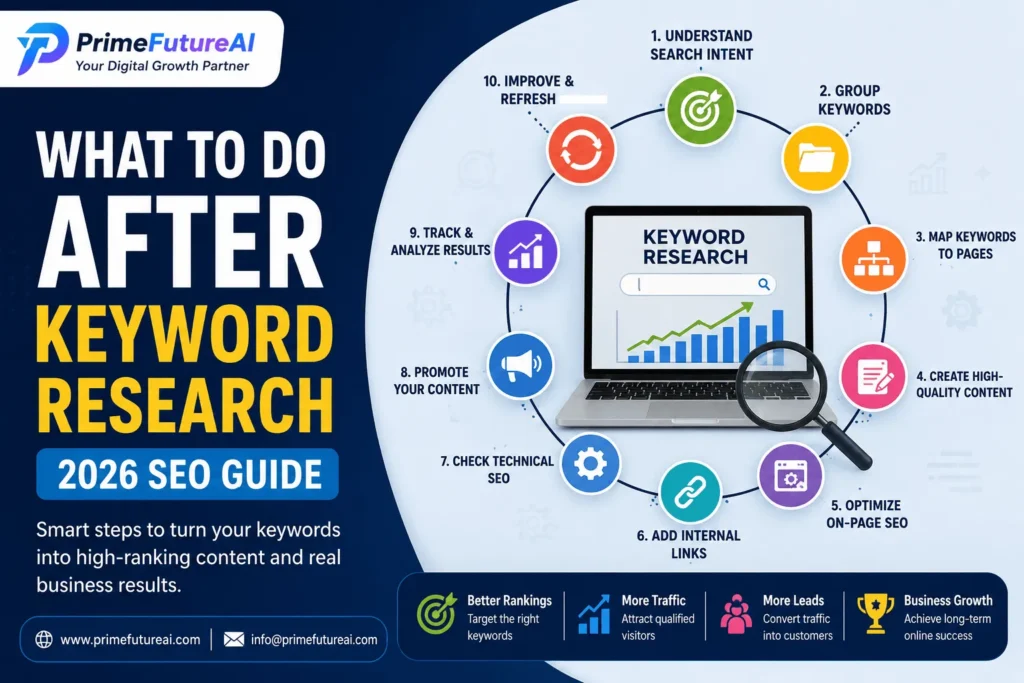
Keyword research is one of the most important parts of SEO, but it is only the beginning. Finding keywords does not automatically bring traffic, leads, or sales. The real value comes from knowing what to do after keyword research and turning your keyword list into a clear SEO strategy.
Once you have identified relevant keywords, the next steps include understanding search intent, grouping similar keywords, mapping them to the right pages, creating useful content, optimizing existing pages, building internal links, improving technical SEO, and tracking performance.
In 2026, SEO is increasingly focused on creating useful experiences for real users rather than simply repeating keywords. Google recommends people-first content that is helpful, reliable, original, and easy to understand.
This guide explains what you should do after completing keyword research, with simple steps and real-life examples.
Why Keyword Research Alone Is Not Enough
Imagine that you own an online clothing store and have discovered 500 useful keywords related to women’s clothing.
You now have a spreadsheet containing terms such as:
- Women’s casual dresses
- Summer dresses for women
- Affordable party dresses
- Cotton dresses online
- Best dresses for summer
- Women’s office wear
- Casual dresses under $50
The research is useful, but the spreadsheet itself does not generate organic traffic.
You still need to decide:
- Which keywords deserve their own pages?
- Which keywords belong on the same page?
- What does the searcher actually want?
- Should you create a blog post, category page, product page, or service page?
- Which keywords should target potential customers?
- How should pages be connected through internal links?
- How will you measure results?
That is why the work after keyword research is just as important as finding the keywords.
Understand Search Intent
The first thing to do after keyword research is determine search intent.
Search intent means the reason behind a person’s search.
For example, someone searching for “what is technical SEO” probably wants information. Someone searching for “technical SEO services” may be looking for a company that provides the service.
Common search intent types include:
Informational Intent
The user wants to learn something.
Examples:
- What is keyword research?
- How does SEO work?
- What is local SEO?
These searches are usually suitable for guides, tutorials, blog posts, and educational resources.
Commercial Investigation
The user is researching options before making a decision.
Examples:
- Best SEO tools
- Best WordPress SEO services
- SEO agency vs freelancer
Comparison pages, reviews, guides, and solution-focused content can work well here.
Transactional Intent
The user is ready to take action.
Examples:
- Buy SEO software
- Hire SEO expert
- WordPress website design service
These keywords may be better suited to product, service, pricing, or landing pages.
Navigational Intent
The searcher is looking for a particular website, company, or page.
Examples:
- PrimeFutureAI
- Google Search Console login
- Facebook Ads Manager
Understanding intent prevents you from creating the wrong type of content for a keyword.
Group Similar Keywords Into Topics
After identifying search intent, organize your keywords into groups.
Do not create a separate page for every keyword variation.
For example, these keywords could potentially belong to one comprehensive topic:
- What is keyword research?
- Keyword research guide
- How to do keyword research
- Keyword research process
- Keyword research steps
Instead of creating five thin articles, you could create one strong guide covering the topic comprehensively.
This approach also makes your website easier to navigate and reduces unnecessary keyword overlap.
Google notes that its language systems can understand related variations and do not require you to use every exact keyword variation on a page.
Example
Suppose a digital marketing agency researches the following keywords:
Main topic: Local SEO
Related terms:
- Local SEO services
- Local SEO for small business
- How local SEO works
- Local search optimization
- Local SEO strategy
The agency could create a main service page for Local SEO Services and supporting educational articles around specific informational questions.
Create a Keyword-to-Page Map
One of the most useful steps after keyword research is keyword mapping.
Keyword mapping means assigning selected keywords to specific website pages.
Create a simple spreadsheet with columns such as:
| Keyword | Search Intent | Target Page | Content Type | Priority |
|---|---|---|---|---|
| SEO services | Transactional | SEO Services | Service Page | High |
| What is SEO | Informational | SEO Guide | Blog | Medium |
| Local SEO services | Transactional | Local SEO Page | Service Page | High |
| SEO tips for small business | Informational | SEO Tips Guide | Blog | Medium |
This prevents different pages from competing for the same primary keyword.
It also gives your content team a clear publishing roadmap.
Decide Which Pages You Need
Once keywords are mapped, determine which pages should be created or improved.
Depending on your business, your keyword research may reveal the need for:
- Homepage optimization
- Service pages
- Product pages
- Category pages
- Location pages
- Blog posts
- Comparison pages
- Case studies
- Landing pages
- FAQ pages
- Resource guides
Do not create pages simply because a keyword has search volume.
A keyword should support a real audience need and fit naturally into your website’s purpose.
Google recommends creating content primarily to help people rather than producing large amounts of content solely to attract search traffic.
Build a Content Strategy
Your keyword list can now become a content calendar.
Instead of publishing random blog posts, organize content around important business topics.
For example, an SEO agency could create a content cluster like this:
Pillar Topic: SEO for Small Businesses
Supporting topics:
- How SEO helps small businesses
- Keyword research for small businesses
- Local SEO tips
- On-page SEO checklist
- Technical SEO basics
- How to measure SEO results
- Common SEO mistakes
- SEO vs paid advertising
The pillar page can link to the supporting articles, while supporting articles can link back to the main guide.
This creates a logical structure for users and search engines.
Analyze the Search Results Before Writing
Before creating content for an important keyword, examine the current search results.
Look at the types of pages appearing for the query.
Ask:
- Are the top results blog posts?
- Are they service pages?
- Are they product pages?
- Are they comparison articles?
- Are there videos?
- Are there local businesses?
- What questions appear in search features?
- What information seems missing?
This helps you understand what users are likely expecting.
Real-Life Example
Suppose you want to target:
“best website design services for small businesses.”
If most results are comparison guides and agency service pages, creating a generic article called “What Is Website Design?” may not match the search intent.
A better page might compare different website design options, explain pricing factors, discuss important features, and help small businesses choose the right service.
Create Helpful, Original Content
Now it is time to create the actual content.
Your keywords should guide the topic, but they should not control every sentence.
Write naturally for the reader.
A strong SEO article should ideally:
- Answer the main question quickly
- Use clear headings
- Provide practical examples
- Explain difficult concepts simply
- Add original insights
- Include useful supporting information
- Avoid unnecessary repetition
- Use relevant internal links
- Provide a logical next step
Google specifically advises creators to focus on original, helpful, reliable, people-first content rather than content made primarily to manipulate rankings.
Avoid Keyword Stuffing
For example, don’t write:
“Our SEO services are the best SEO services because our SEO services provide professional SEO services for businesses looking for SEO services.”
That sounds unnatural.
Instead, explain the service clearly and use related language naturally.
Google also states that excessive keyword repetition can create a poor experience and is not a recommended SEO practice.
Optimize Existing Content
Keyword research is not only for new content.
Your research may reveal that an existing page already has the potential to rank for a valuable keyword.
Instead of publishing another article, improve the existing page.
Check:
- Page title
- Main heading
- Subheadings
- Content depth
- Search intent
- Internal links
- Images
- Image alt text
- Meta description
- URL
- Calls to action
- Outdated information
For example, suppose your website already has an article about “SEO tips” that receives some impressions but very few clicks.
Keyword research may reveal additional related searches.
You can improve the article by answering those questions, reorganizing sections, improving the title, adding examples, and strengthening internal links.
Google recommends reviewing and updating content when needed rather than treating content as something that should simply be published once and forgotten.
Improve On-Page SEO
After deciding what each page should target, optimize the page itself.
Important on-page elements include:
SEO Title
Create a clear title that accurately describes the page.
Example:
SEO Services for Small Businesses | PrimeFutureAI
Meta Description
Write a concise description that explains the page and encourages relevant users to click.
Headings
Use a logical heading structure to make the content easier to scan.
URL
Keep URLs descriptive and understandable.
Images
Use relevant, high-quality images and descriptive alt text where appropriate.
Content
Make sure the primary topic is clearly addressed without unnatural keyword repetition.
Google’s SEO guidance recommends clear titles, useful descriptions, readable content, descriptive URLs, and relevant images.
Add Internal Links
Internal linking is another important task after keyword research.
An internal link connects one page on your website to another page on the same website.
For example:
A blog post about keyword research could link to:
- SEO services
- On-page SEO
- Content writing
- Technical SEO
- Local SEO
This helps visitors discover related information.
It also helps search engines understand the relationship between different pages. Google explains that links are an important way search engines discover pages and recommends useful, descriptive link text.
Example
Instead of:
Click here to learn more.
Use:
Learn more about our keyword research services.
The second example provides more context.
Check Technical SEO
Great content cannot reach its full potential if important technical problems prevent search engines from accessing or understanding your pages.
After keyword research and content planning, review technical areas such as:
- Mobile usability
- Page loading performance
- Indexability
- Crawlability
- Broken links
- Redirects
- Canonical URLs
- XML sitemap
- HTTPS
- Duplicate pages
- URL structure
Google recommends checking whether search engines can crawl and understand your pages and provides Search Console tools for monitoring search performance and inspecting URLs.
Optimize Your Conversion Path
SEO should not be viewed only as a traffic-generation activity.
Ask yourself:
What should the visitor do after reading this page?
Depending on the page, the next step might be:
- Contact your business
- Request a quote
- Book a consultation
- Buy a product
- Download a resource
- Read another article
- Subscribe to updates
Real-Life Example
Imagine a web design company ranks for:
“website design services for startups.”
Getting visitors is useful, but the business needs a clear next step.
A strong page could explain the service, show examples, discuss the process, answer common questions, and end with a clear Request a Website Consultation CTA.
This turns SEO traffic into a potential business opportunity.
Promote Your New Content
Publishing a page does not mean you have to wait passively for visitors.
You can promote useful content through:
- Social media
- Email newsletters
- Business communities
- Industry publications
- Partnerships
- Relevant outreach
- Existing customer networks
Google also notes that promotion can help new content get discovered by people who are interested in the subject.
The goal should be genuine exposure, not artificial link manipulation.
Track Performance After Publishing
After your content goes live, monitor what happens.
Useful SEO metrics include:
- Impressions
- Clicks
- Organic traffic
- Click-through rate
- Keyword positions
- Indexed pages
- Conversions
- Leads
- Engagement
- Revenue from organic traffic
Google Search Console can help website owners understand how their pages perform in Google Search.
Do not panic if a new page does not rank immediately. Google explains that changes can take anywhere from hours to months to become reflected in search results, so SEO requires ongoing evaluation rather than instant judgments.
Refresh and Improve Your SEO Strategy
SEO is an ongoing process.
A keyword that performs well today may become more competitive later. Search behavior can change, competitors can publish stronger pages, and your own business can introduce new products or services.
Review important pages regularly.
Look for:
- Declining traffic
- Falling rankings
- New competitors
- Outdated information
- New keyword opportunities
- Missing search-intent sections
- Weak internal links
- Low conversion rates
Then improve the pages based on what the data tells you.
Real-Life Example: What Happens After Keyword Research?
Let’s take a fictional small digital marketing agency called BrightGrowth.
The agency researches keywords and finds:
- SEO agency for small business
- affordable SEO services
- local SEO services
- SEO audit services
- SEO tips for small business
Instead of writing one article for every keyword, the agency creates a strategy.
Step 1: Main Service Page
It creates an SEO Services page targeting commercial keywords.
Step 2: Supporting Service Pages
It creates dedicated pages for:
- Local SEO
- Technical SEO
- SEO Audits
Step 3: Educational Content
It publishes guides covering:
- SEO tips for small businesses
- How an SEO audit works
- Local SEO basics
Step 4: Internal Linking
The educational articles link to relevant service pages.
Step 5: Conversion
Each service page includes a clear consultation CTA.
Step 6: Measurement
The agency monitors impressions, clicks, rankings, leads, and conversions.
The important point is that the original keyword spreadsheet has become an organized SEO system rather than simply a list of search terms.
How PrimeFutureAI Helps Businesses Online
PrimeFutureAI helps businesses build a stronger online presence through practical digital marketing and SEO solutions.
Its services can support businesses with areas such as technical SEO, on-page SEO, off-page SEO, keyword research, SEO content writing, local SEO, web design and development, social media marketing, Meta Ads, and YouTube SEO.
For example, a business that has completed keyword research but does not know how to turn its keywords into pages can benefit from a structured SEO strategy. PrimeFutureAI can help identify opportunities, organize keywords, optimize website content, improve technical elements, and develop content designed around relevant audiences and business goals.
The bigger objective is not simply to collect keywords or chase rankings. It is to help businesses attract relevant visitors and create a website experience that supports long-term online growth.
Common Mistakes to Avoid After Keyword Research
Creating One Page for Every Keyword
Similar keywords often have overlapping intent. Creating dozens of nearly identical pages can make your website unnecessarily complicated.
Ignoring Search Intent
A high-volume keyword is not valuable if your page does not satisfy what the searcher wants.
Focusing Only on Search Volume
Search volume is only one part of keyword evaluation. Relevance, competition, intent, business value, and conversion potential also matter.
Stuffing Keywords Into Content
Write naturally. Do not repeat a keyword simply to increase its frequency.
Forgetting Existing Pages
Sometimes improving an existing page is more useful than creating another article.
Publishing Without Internal Links
A new page should have a logical relationship with relevant pages on your website.
Expecting Immediate Results
SEO usually requires testing, monitoring, and improvement over time.
What to Do After Keyword Research: Quick Action Plan
Once your keyword research is complete, follow this sequence:
- Understand search intent.
- Group related keywords.
- Identify primary and supporting topics.
- Map keywords to existing or new pages.
- Analyze the current search results.
- Build a content strategy.
- Create useful, original content.
- Optimize existing pages.
- Improve on-page SEO.
- Add relevant internal links.
- Check technical SEO.
- Add clear conversion opportunities.
- Promote useful content.
- Track SEO performance.
- Refresh your strategy based on data.
This workflow turns keyword research into an actionable SEO plan.
FAQs About What to Do After Keyword Research
Q: What should I do immediately after keyword research?
Start by understanding the search intent behind your most valuable keywords. Then group related keywords and map them to the appropriate website pages.
Q: Should every keyword have its own page?
No. Closely related keywords with the same search intent can often be covered by one strong page. Create separate pages when the user intent or topic is meaningfully different.
Q: What comes after keyword mapping?
After keyword mapping, you can create or optimize pages, build your content calendar, improve internal linking, and develop your on-page SEO strategy.
Q: Should I create new content or update old content?
It depends on your website. If an existing page already targets the topic and has useful authority or traffic, improving it may make more sense. If no suitable page exists, create new content.
Q: How long does SEO take after keyword research?
There is no universal timeline. Some changes may appear relatively quickly, while others can take weeks or months. Google recommends giving changes time and evaluating their impact over several weeks.
Q: Is search volume the most important keyword metric?
No. Search volume is useful, but relevance, search intent, competition, business value, and conversion potential should also influence your decisions.
Q: How many keywords should I use in one article?
There is no magic number. Focus on completely answering the topic naturally instead of targeting an arbitrary keyword count or density. Google explicitly says there is no preferred word count for ranking.
Q: What is the biggest mistake after keyword research?
One of the biggest mistakes is stopping at the spreadsheet. Keywords only become valuable when you turn them into useful pages, content, internal links, and measurable business outcomes.
Final Thoughts
Keyword research gives you direction, but it does not complete your SEO work. The real process begins when you transform those search terms into a structured website and content strategy.
The most effective approach in 2026 is to think beyond individual keywords. Understand why people search, what information they need, which page can satisfy that need, and what action you want them to take afterward.
Group related topics, map keywords carefully, create original content, improve existing pages, build meaningful internal links, monitor technical SEO, and measure real business results.
Most importantly, don’t create content simply because a keyword has search volume. Create content because it solves a real problem for your audience. That people-first approach can help turn keyword research into sustainable organic visibility and meaningful business growth.