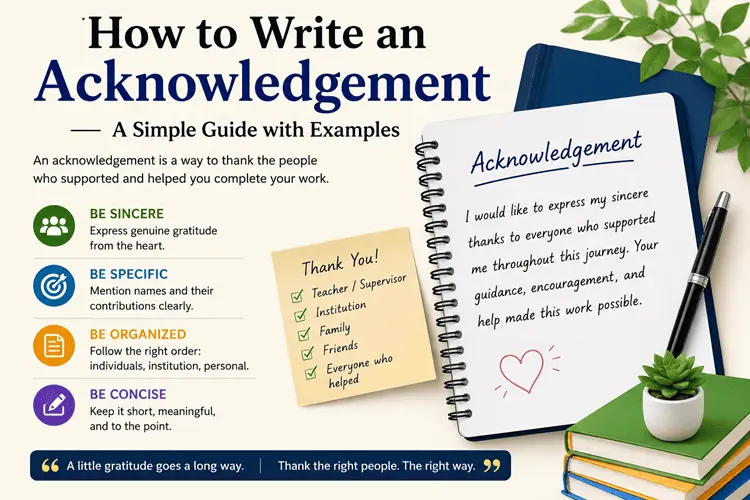
Knowing how to write an acknowledgement helps you express gratitude in a clear, respectful, and professional manner. Whether you’re completing a thesis, research paper, school assignment, internship report, book, or business document, a thoughtful acknowledgement recognizes the people who supported your work.
In this guide, you’ll learn the essential steps, the proper structure, and the best writing style for different situations. You’ll also find practical examples that you can adapt to your own work.
At PrimeFutureAi, we provide easy-to-follow writing resources for students, researchers, and professionals across the USA. This guide is designed to help you create a meaningful acknowledgement with confidence.
Let’s begin.
What Is an Acknowledgement?
An acknowledgement is a dedicated section where you express appreciation to the individuals or organizations that contributed to the completion of your work. It is commonly included in academic papers, theses, projects, books, reports, and professional documents to recognize valuable guidance, encouragement, or assistance.
This section allows you to thank supervisors, teachers, mentors, colleagues, family members, friends, sponsors, or institutions that played a meaningful role during your journey. Every acknowledgement is unique because it reflects the support you personally received.
Unlike the main content of your document, an acknowledgement is written in a warm yet professional tone. It focuses on sincere appreciation rather than facts, research, or technical explanations, so citations are generally unnecessary.
Including an acknowledgement demonstrates respect for those who helped you succeed. It also highlights your professionalism, humility, and willingness to recognize the contributions of others, leaving readers with a positive final impression.
Purpose of Writing an Acknowledgement
An acknowledgement is more than a simple expression of thanks. It recognizes the people and organizations whose guidance, encouragement, or support contributed to the success of your work. Including this section reflects your appreciation while giving proper recognition to those who made a difference.
Here are some key reasons why an acknowledgement is important:
- Recognizes the contributions of people who supported your work.
- Demonstrates gratitude, respect, and professionalism.
- Reflects honesty and strong academic or professional values.
- Strengthens relationships with mentors, supervisors, colleagues, and supporters.
- Adds a personal and meaningful touch to formal documents.
- Leaves a positive impression on readers, reviewers, and evaluators.
A thoughtful acknowledgement is often one of the first sections readers notice. When written sincerely and professionally, it shows that you value the contributions of others and appreciate the support you received throughout your journey.
When Should You Write an Acknowledgement?
An acknowledgement should be included whenever your work has been supported, guided, or influenced by others. It gives you an opportunity to formally recognize the individuals or organizations that contributed to the successful completion of your project or document.
Common situations where an acknowledgement is appropriate include:
- School and college assignments
- University theses and dissertations
- Research papers and academic publications
- Books, eBooks, and manuscripts
- Business reports and professional documents
- Internship reports and training projects
- Case studies, presentations, and technical reports
In general, if your work benefited from advice, supervision, financial assistance, or personal support, adding an acknowledgement is a thoughtful and professional way to express your appreciation. Even though it is usually brief, it reflects gratitude and respect for everyone who helped along the way.
Types of Acknowledgement
Acknowledgements can vary depending on the purpose of your document and the audience it is intended for. While the overall goal is to express appreciation, the structure, tone, and people you recognize may differ based on the type of work. Below are some of the most common acknowledgement formats.
Acknowledgement for a Project
A project acknowledgement is commonly included in school, college, or university project reports. It is usually placed at the beginning of the document and gives credit to those who provided guidance, resources, or encouragement throughout the project.
A project acknowledgement often recognizes:
- Project supervisor or teacher
- School or college administration
- Parents or family members
- Friends, classmates, or team members
- Anyone who offered valuable support or assistance
The writing style should be polite, clear, and professional while remaining sincere. Most project acknowledgements are brief, typically one or two well-organized paragraphs, focusing only on the individuals who made a meaningful contribution to the project’s completion.
Acknowledgement for a Thesis or Research Paper
A thesis or research paper acknowledgement provides an opportunity to recognize the individuals and organizations that contributed to your academic work. It is typically included in the front section of the document, before the main chapters, and reflects your appreciation for the guidance and support you received during your research.
A well-structured thesis acknowledgement usually thanks contributors in a logical order, beginning with academic support and ending with personal appreciation. Commonly recognized contributors include:
- Thesis supervisor or research advisor
- Committee members or academic reviewers
- University, department, or research institution
- Scholarship providers, sponsors, or funding organizations
- Research collaborators, laboratory staff, or assistants
- Family members and close friends for their encouragement
The tone should remain professional, respectful, and sincere. Most thesis acknowledgements are limited to one page, while doctoral dissertations may allow a slightly longer section if needed. Although academic writing is generally formal, using the first person in the acknowledgement is widely accepted because it reflects your personal gratitude.
Acknowledgement for a Book
A book acknowledgement gives authors the chance to recognize the people who played an important role in bringing their work from an idea to a finished publication. This section usually appears at the beginning or end of a book and allows writers to express appreciation for both professional guidance and personal encouragement.
A book acknowledgement may include thanks to:
- Literary agent or publishing team
- Editors, proofreaders, and designers
- Early readers, reviewers, or manuscript contributors
- Friends and family for their ongoing support
- Mentors or individuals who inspired the book’s topic
Unlike academic acknowledgements, book acknowledgements often have a more personal and conversational style. Authors are free to share brief stories, heartfelt messages, or memorable experiences while keeping the content genuine and respectful. The length can vary from a short paragraph to a full page, depending on the number of contributors and the level of detail the author wishes to include.
Acknowledgement Letter for Business
A business acknowledgement letter is a professional communication used to confirm that a document, request, payment, application, or other important item has been successfully received. It assures the sender that their submission has reached the intended recipient and is being reviewed or processed.
A standard business acknowledgement letter generally includes:
- The date the item was received
- A clear description of the received document, payment, or request
- Confirmation that the submission has been recorded or is under review
- Information about the next steps or the expected response time
The language should be formal, concise, and professional. Unlike academic acknowledgements, business acknowledgement letters focus on confirming receipt rather than expressing personal gratitude. In most cases, a short message of one or two paragraphs is sufficient to communicate the necessary information clearly.
How to Write an Acknowledgement Step by Step
Writing an acknowledgement becomes much easier when you follow a clear structure. No matter whether you’re preparing a project, thesis, research paper, book, or professional document, these steps will help you create a sincere and well-organized acknowledgement.
Step 1: Begin with a Grateful Opening
Start by expressing your appreciation in a polite and meaningful way. The opening sentence introduces the purpose of the acknowledgement and sets a respectful tone for the rest of the section. It should briefly convey your gratitude before mentioning specific individuals or organizations.
Here are a few professional opening examples:
- I would like to sincerely thank everyone who supported me throughout this work.
- I am truly grateful to those who contributed their time, guidance, and encouragement.
- I would like to acknowledge the valuable assistance I received during this project.
- This achievement would not have been possible without the support of many individuals.
Keep the introduction concise and genuine. A strong opening creates a positive first impression, while the following paragraphs can provide more specific recognition to the people who made your work possible.
Step 2: Recognize the People Who Contributed
After your opening statement, acknowledge the individuals or organizations that played a meaningful role in completing your work. Begin with those who had the greatest impact, such as supervisors, advisors, mentors, or project leaders, and then move on to others who offered support.
When mentioning someone, explain how they contributed instead of offering only a general thank-you. Referring to their guidance, expertise, encouragement, or practical assistance makes your acknowledgement more personal and meaningful.
A simple way to organize each acknowledgement is:
- Mention the person’s name.
- State their position or relationship to your work.
- Briefly explain their contribution.
- End with a sincere expression of appreciation.
If several people provided similar support, you can thank them together in one statement to keep the acknowledgement clear, concise, and well organized.
Step 3: Acknowledge Your Institution or Supporting Organization
If your work was completed through a school, college, university, company, or any other organization, include a brief note of appreciation for their support. Recognizing institutions demonstrates professionalism and highlights the role they played in helping you achieve your goals.
You may thank an institution for providing:
- Academic guidance or supervision
- Research facilities and learning resources
- Financial support, scholarships, or grants
- Technical assistance or specialized equipment
- Training opportunities or administrative support
When writing this section, clearly mention the name of the institution or organization and briefly explain how it contributed to your work. If your project was funded through a scholarship or research grant, it is also appropriate to acknowledge the sponsoring organization, as many funding programs expect formal recognition in published work.
Step 4: Use a Professional and Sincere Tone
The way you write your acknowledgement is just as important as the people you thank. Your message should express genuine appreciation while maintaining a respectful and professional style. A balanced tone makes your acknowledgement more meaningful and appropriate for both academic and professional documents.
Follow these writing tips to maintain the right tone:
- Write with courtesy and respect from beginning to end.
- Keep your language clear, simple, and professional.
- Avoid slang, jokes, or overly casual expressions.
- Use full names and official titles whenever appropriate.
- Keep your sentences concise and easy to understand.
- Express gratitude naturally without sounding exaggerated.
Instead of writing broad statements that thank everyone at once, recognize individuals or groups for their specific contributions whenever possible. A thoughtful and personalized acknowledgement leaves a stronger impression and shows genuine appreciation for the support you received.
Step 5: Finish with a Meaningful Closing
Conclude your acknowledgement by expressing appreciation to those who provided personal encouragement throughout your journey. This is the ideal place to recognize family members, close friends, or anyone who offered motivation, understanding, or emotional support while you completed your work.
Your closing should be genuine, concise, and heartfelt. Rather than repeating earlier thanks, use this section to acknowledge the people who stood by you during the process and helped you stay motivated.
A strong ending should:
- Thank family members or close supporters.
- Recognize emotional encouragement and motivation.
- Leave a positive and appreciative final impression.
- Keep the message brief and sincere.
A short closing of two or three sentences is usually enough to end your acknowledgement on a warm and respectful note, completing it in a thoughtful and professional way.
Acknowledgement Format and Structure
A well-organized acknowledgement makes your document look polished and easy to read. Before you begin writing, it’s helpful to understand the typical structure and recommended length for different types of acknowledgements. Keeping your content concise ensures your message remains clear and professional.
Recommended Word Count
The ideal length depends on the type of document you are preparing:
| Document Type | Suggested Length |
|---|---|
| School Project | 100–150 words |
| College Project | 150–250 words |
| Thesis or Dissertation | 200–400 words (about one page) |
| Book | 150–500 words |
| Business Acknowledgement Letter | 50–150 words |
While these word counts serve as general recommendations, you should always follow the formatting requirements provided by your school, university, publisher, or organization. If official guidelines are available, they should take priority over standard writing practices to ensure your acknowledgement meets the required format.
Tone and Language Tips
The effectiveness of an acknowledgement depends on how naturally and respectfully it is written. Your words should express genuine appreciation while maintaining a professional style that suits the purpose of your document.
Follow these writing tips to improve clarity and tone:
- Use first-person language when expressing personal gratitude.
- Keep your sentences simple, direct, and easy to follow.
- Choose clear words instead of overly formal or complicated vocabulary.
- Prefer active voice to make your writing more engaging.
- Review your acknowledgement carefully to ensure it flows naturally and reads smoothly.
A strong acknowledgement should feel sincere rather than scripted. Writing in a clear, authentic voice helps readers connect with your message and makes your appreciation more meaningful.
Acknowledgement Sample for a Project
The following example can be used as a reference when writing an acknowledgement for a school or college project. Edit the names and details to match your own experience and the people who supported your work.
Sample:
“I would like to sincerely thank my project supervisor, [Teacher’s Name], for their valuable guidance, constructive feedback, and constant encouragement throughout this project. I also extend my appreciation to [School/College Name] for providing the facilities and learning environment that made this work possible. My heartfelt thanks go to my parents and family for their unwavering support and motivation. Finally, I am grateful to my classmates and friends for their cooperation, helpful suggestions, and encouragement during every stage of this project.”
Use this sample as a starting point rather than copying it exactly. Personalizing your acknowledgement with specific contributions and genuine appreciation will make it more meaningful and professional.
Acknowledgement Sample for a Thesis
The sample below demonstrates a professional way to write a thesis acknowledgement. You can modify the names, institution, and details to reflect your own academic experience.
Sample:
I sincerely thank my thesis supervisor, Dr. [Name], for their invaluable guidance, insightful advice, and continuous encouragement throughout this research. Their expertise and support played a significant role in the successful completion of this study.
I also appreciate the members of my department and [University Name] for providing the academic resources, facilities, and learning environment that supported my research. My gratitude extends to everyone who contributed valuable feedback and assistance during this process.
Lastly, I would like to express my heartfelt thanks to my family and friends for their patience, encouragement, and unwavering belief in me. Their constant support inspired me to overcome challenges and complete this work with confidence.
This sample provides a clear structure that begins with academic recognition, followed by institutional appreciation, and concludes with personal gratitude. Customize the content to make your acknowledgement sincere and relevant to your own journey.
Acknowledgement Sample for a Book
The following example illustrates how an author can acknowledge the people who contributed to the creation and publication of a book. Feel free to personalize the names and details to reflect your own experience.
Sample:
I would like to extend my sincere appreciation to my editor, [Name], whose valuable insights and careful guidance helped shape this manuscript into its final form. My gratitude also goes to my publisher and literary agent for believing in this project and supporting it from the very beginning.
I am thankful to my early readers and reviewers for their thoughtful feedback, which helped improve every chapter. Their suggestions and encouragement were invaluable throughout the writing process.
Finally, I owe my deepest thanks to my family and friends for their endless patience, motivation, and unwavering belief in me. Above all, I am grateful to every reader who chooses to spend their time with this book. Your support gives purpose to every page.
This sample uses a warm and personal tone while remaining polished and professional. Adapt it by adding specific names, experiences, or messages to create an acknowledgement that genuinely reflects your journey as an author.
Acknowledgement Letter Sample
The sample below shows how to write a professional acknowledgement letter to confirm that an application, payment, document, or request has been successfully received. Replace the placeholders with your own information before using it.
Sample:
Dear [Recipient Name],
We are writing to confirm that we have successfully received your [application/document/payment] submitted on [Date]. Your submission has been recorded and is currently being processed by our team.
We appreciate your patience while we complete the review. You can expect an update within [timeframe]. If additional information is required, we will contact you using the details you provided.
Thank you for your submission. We appreciate your cooperation and look forward to assisting you further.
Kind regards,
[Your Name]
[Job Title]
[Organization Name]
This template is suitable for a wide range of professional situations, including acknowledging the receipt of applications, official documents, payments, inquiries, or other business correspondence. Adjust the wording as needed to match your organization’s communication style.
Common Mistakes to Avoid
A well-written acknowledgement should be clear, respectful, and focused. Avoiding common writing mistakes will help you create a section that feels genuine and professional.
Here are some errors to avoid:
- Writing vague statements: Instead of offering a general thank-you, mention the individuals or organizations who made a meaningful contribution and briefly explain their role.
- Including unnecessary names: Acknowledge only those who directly supported your work. A long list of names can reduce the impact of your message.
- Using an inappropriate tone: Maintain a balance between professionalism and sincerity. Avoid overly casual language as well as language that feels overly formal or impersonal.
- Misspelling names or titles: Verify the spelling of every person’s name and their official designation before finalizing your acknowledgement.
- Overlooking institutions or sponsors: If your school, university, company, or funding organization provided important support, be sure to recognize them appropriately.
- Making the acknowledgement too lengthy: Keep your writing concise and relevant. Focus on expressing appreciation without adding unnecessary details or repetition.
Review your acknowledgement before submitting it to ensure it is accurate, well-structured, and free from grammatical or spelling errors. A polished acknowledgement leaves a positive and lasting impression on readers.
Tips for Writing a Memorable Acknowledgement
A thoughtful acknowledgement is more than a list of names—it reflects genuine appreciation and professionalism. With a little planning and careful editing, you can create a message that feels authentic and leaves a positive impression.
Consider these helpful tips when writing your acknowledgement:
- Plan before you write: Make a list of everyone who contributed and arrange them in a logical order based on their level of support.
- Explain each contribution: Briefly mention how each person or organization helped instead of offering a general thank-you.
- Write in your own words: Personalizing your acknowledgement makes it more meaningful than relying entirely on a generic template.
- Proofread thoroughly: Check your writing for grammar, spelling, punctuation, and formatting errors before submitting or publishing.
- Get feedback: Ask a teacher, colleague, or friend to review your acknowledgement and suggest improvements.
- Use an appropriate style: Keep the tone consistent with the type of document, whether it’s an academic paper, business report, project, or book.
A well-crafted acknowledgement doesn’t have to be long. Clear wording, sincere gratitude, and a professional structure are all you need to create an acknowledgement that readers will appreciate.
Conclusion
An acknowledgement is a meaningful way to recognize the people and organizations that contributed to your success. Whether your document is academic, professional, or personal, taking the time to express sincere appreciation reflects respect, gratitude, and professionalism.
The key to writing an effective acknowledgement is to keep it clear, authentic, and well organized. Mention the most important contributors, explain their role briefly, and use a tone that matches the purpose of your document. A thoughtful acknowledgement doesn’t need to be lengthy—it simply needs to be genuine.
Use the guidelines, formatting tips, and sample examples in this article as a starting point, then personalize your acknowledgement to reflect your own experience. A few carefully chosen words of thanks can leave a lasting impression on both the people you recognize and those who read your work.
At Prime Future AI, we create practical writing resources, educational guides, and SEO-focused content to help students, professionals, and businesses achieve their goals. Our mission is to provide reliable, easy-to-follow information that helps you write with confidence and communicate more effectively.
FAQ’s
1. What should you include in an acknowledgement?
A well-written acknowledgement should recognize the individuals and organizations that supported your work. This may include supervisors, teachers, mentors, institutions, sponsors, colleagues, friends, or family members. Briefly mention how each contributed to your success.
2. What is the ideal length of an acknowledgement?
The length depends on the type of document. Project acknowledgements are usually short, while theses and dissertations may require a more detailed section. In most cases, keeping your acknowledgement between 100 and 400 words is sufficient unless specific guidelines state otherwise.
3. How should an acknowledgement be organized?
A standard acknowledgement begins with a general expression of gratitude, followed by recognition of key contributors in order of importance. It should also mention any supporting institution or organization and conclude with a brief personal note of appreciation.
4. Is it acceptable to use first-person language?
Yes. Using first-person pronouns such as “I” and “my” is appropriate because an acknowledgement reflects your personal gratitude. This style is widely accepted in academic, professional, and creative writing.
5. How is an acknowledgement different from a dedication?
An acknowledgement thanks the people or organizations that contributed to your work through guidance, support, or resources. A dedication, on the other hand, is a personal tribute that honors someone important to you and is usually much shorter and more emotional in tone.