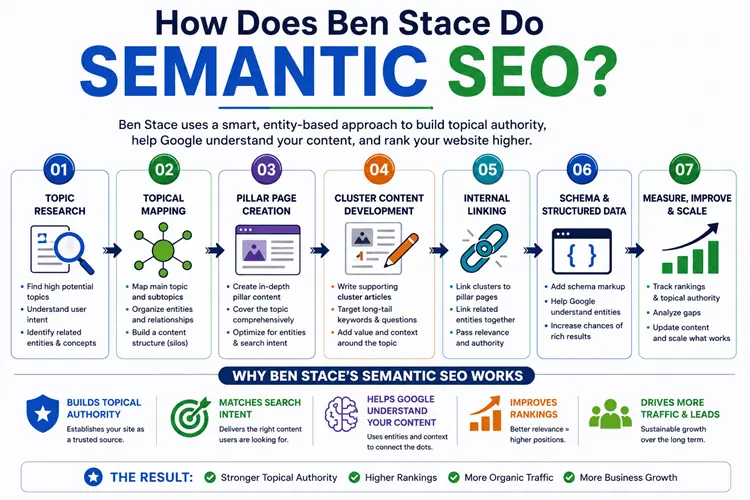
Many SEO professionals still focus mainly on adding keywords to their content. How Ben Stace Do Semantic SEO is different because it focuses more on the real meaning of a topic and what users are actually searching for instead of only targeting keywords.
This content strategy helps websites build stronger relevance, making it easier for search engines to understand each page. That is why many digital marketers are paying attention to his methods and discussing them in SEO communities and online marketing groups across the USA.
In this guide, you will discover how Ben Stace do Semantic SEO, internal linking methods, and content structure for building topical authority and better rankings. and learn practical ideas that you can use to improve your own website’s content and search performance.
Who Is Ben Stace and Why His Semantic SEO Strategy Is Important?
Ben Stace is an SEO consultant and digital marketing professional from Melbourne. He is known for creating SEO strategies that focus on semantic search, helping businesses improve their online visibility by building content around topics instead of relying only on keywords.
With many years of experience in the SEO industry, he has earned attention by openly explaining the methods and processes he uses. Rather than keeping his techniques private, he shares practical strategies that marketers and business owners can understand and apply.
One reason his work stands out is his use of modern technologies such as artificial intelligence (AI) and natural language processing (NLP). He combines research, real-world testing, and creative planning to develop SEO strategies that match how today’s search engines understand content.
Instead of depending on assumptions, Ben Stace regularly tests new ideas, measures the results, and improves his methods based on real data. This practical approach has made his SEO framework valuable for websites in different industries.
His content strategy is designed to satisfy both readers and search engines. By focusing on clear website structure, related topics, and user search intent, he creates content that is useful for visitors while also helping search engines better understand each page.
Ben Stace’s View on Semantic SEO
Before exploring Ben Stace’s SEO process, it is important to understand the idea behind semantic SEO.
Semantic SEO is a content optimization method that focuses on the full meaning of a topic instead of repeating the same keywords. The goal is to create content that answers related questions, covers connected ideas, and gives search engines a complete understanding of the subject.
Modern search engines like Google do not rank pages by counting keywords alone. They also examine how words, topics, and concepts are connected to determine what a page is about and whether it provides the information users are looking for. This allows search engines to deliver more accurate and relevant results.
Traditional SEO mainly focuses on how often a keyword appears on a page.
Semantic SEO takes a different approach by asking whether the content explains the topic completely and provides real value to the reader.
Instead of relying on keyword repetition, semantic SEO builds content around related ideas, user intent, and the natural connection between topics. It helps search engines understand the full context of a page by using relevant terms, entities, and well-organized information.
Modern Google algorithms are now advanced enough to recognize similar words, connected concepts, and the purpose behind a user’s search. Rather than checking for exact keyword matches, Google looks at how well a page answers the topic and whether it demonstrates expertise.
Because of this, semantic SEO helps create stronger topical authority, making it more likely for content to earn stable rankings and remain competitive over time.
How Does Ben Stace Do Semantic SEO Strategy?
Ben Stace follows a clear and organized SEO process instead of making decisions based on assumptions. His strategy is built around research, planning, and a structured workflow that can be repeated for different websites and topics.
The process starts by finding the main keyword along with related topics, entities, and search terms connected to the subject. After collecting this information, he creates a content plan that shows how each topic is linked. He then develops a detailed pillar page and supports it with several related articles that connect through internal links. This structure helps search engines understand the topic better while improving the website’s overall authority.