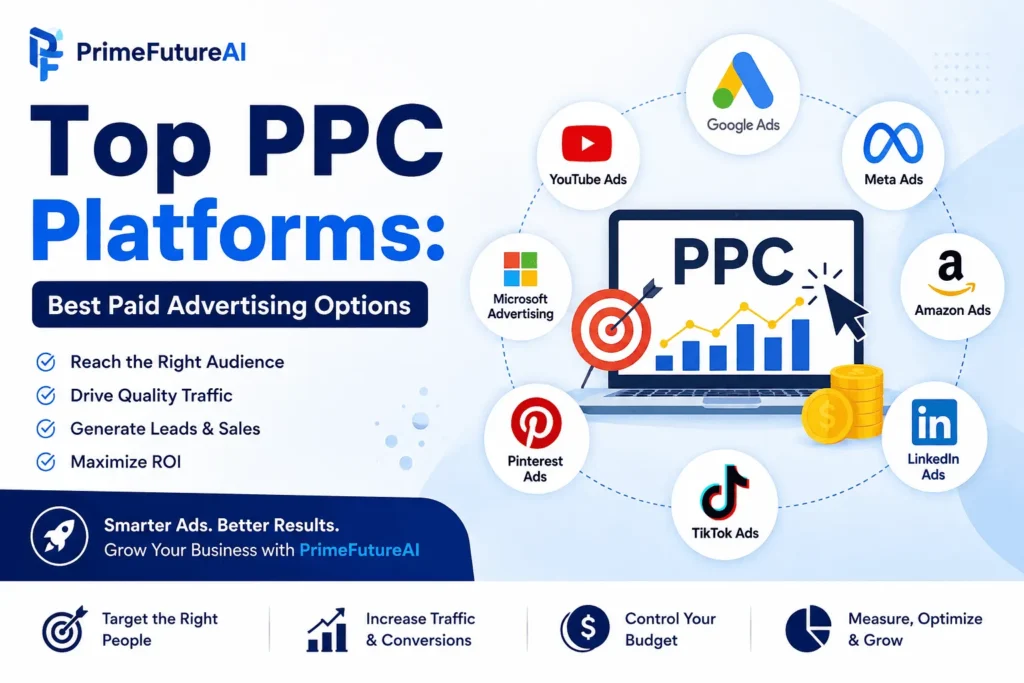
Pay-per-click advertising has become one of the most practical ways for businesses to attract targeted visitors, generate leads, promote products, and increase online sales. Instead of waiting for organic traffic to grow, businesses can use paid advertising to reach potential customers when they are actively searching, browsing, comparing, or discovering products and services.
However, choosing the right advertising network is not always easy. Every platform has different audiences, targeting options, ad formats, bidding systems, and costs. The platform that works extremely well for an online store may not be the best choice for a software company or professional service provider.
This guide explores the top ppc platforms, explains what makes each one useful, and shows how businesses can decide where to invest their advertising budget.
What Is PPC Advertising?
PPC stands for pay-per-click. It is an online advertising model where advertisers generally pay when someone clicks on their advertisement.
For example, imagine a company selling accounting software. The company could create an advertisement for a search such as “small business accounting software.” When someone clicks the advertisement, the advertiser may be charged for that click.
PPC campaigns can appear on search engines, social networks, shopping platforms, websites, and other digital properties.
The major advantages include:
- Fast access to targeted traffic
- Flexible advertising budgets
- Audience and keyword targeting
- Measurable campaign performance
- Multiple ad formats
- Ability to test different messages
- Opportunities to generate leads and sales
The top ppc platforms differ significantly in how they deliver these benefits, which is why businesses should evaluate them according to their specific goals rather than simply choosing the platform with the largest audience.
Why Choosing the Right PPC Platform Matters?
A large advertising audience does not automatically mean better results.
Suppose two companies each spend $1,000 on advertising. One company may generate hundreds of clicks but very few customers. The other may receive fewer clicks but generate valuable leads and sales.
This happens because traffic quality matters as much as traffic quantity.
A successful platform should match:
- Your target audience
- Your product or service
- Your advertising objective
- Your customer journey
- Your available budget
- Your conversion process
- Your expected customer value
Current paid-media comparisons show substantial differences in CPC and conversion performance between major platforms, reinforcing the idea that average industry numbers should be treated as starting points rather than guaranteed results.
Top PPC Platforms to Consider
1. Google Ads
Google Ads is one of the most important choices for businesses that want to capture existing search demand.
People frequently use search engines when they already have a problem, need, or purchasing intention. A person searching for “emergency plumber near me,” for example, may be much closer to becoming a customer than someone who simply sees a plumbing advertisement while browsing social media.
Google’s advertising ecosystem supports several formats, including search, shopping, video, display, and automated campaign solutions.
Why Google Ads Is Popular?
Its biggest advantage is intent.
Businesses can target people based on what they are searching for, making it particularly useful for:
- Local services
- Professional services
- E-commerce
- Software
- Travel businesses
- Home services
- Online education
- Healthcare-related businesses
- B2B services
Google Ads can also support different stages of the customer journey. Search campaigns can capture existing demand, while display and video advertising can help introduce or remind audiences about a brand.
Real-Life Example
A local roofing company wants more customers during the storm season. Instead of displaying advertisements randomly, it can target searches related to roof repair, emergency roofing, and roof replacement.
If the landing page provides clear services, contact information, testimonials, and an easy quote request, paid search traffic can potentially turn into qualified leads.
2. Microsoft Advertising
Microsoft Advertising is another strong option for businesses that want search traffic outside Google’s ecosystem.
It can be particularly interesting for companies that want to reach desktop-oriented audiences or explore potentially less competitive search inventory.
One notable advantage is its connection with professional audience information through Microsoft’s advertising ecosystem. This can make the platform worth testing for certain B2B campaigns.
Best Uses
Microsoft Advertising can work well for:
- B2B companies
- Professional services
- Local businesses
- Software companies
- E-commerce brands
- Businesses looking for additional search traffic
Real-Life Example
A business consultancy already receives leads from Google Ads but wants another source of qualified visitors. Instead of moving its entire budget, the company could test a smaller Microsoft Advertising campaign using proven search terms.
If the cost per qualified lead is attractive, the company can gradually increase spending.
3. Meta Ads
Meta’s advertising ecosystem, including Facebook and Instagram, is particularly useful for visual marketing, audience discovery, remarketing, and consumer-focused campaigns.
Unlike search advertising, social advertising often reaches people before they actively search for a product.
That makes Meta useful for creating demand.
Best Uses
Meta Ads can be effective for:
- Fashion brands
- Beauty businesses
- Food products
- Lifestyle products
- Online stores
- Mobile applications
- Events
- Digital products
- Consumer services
Businesses can experiment with images, short videos, carousels, product advertisements, and other creative formats.
Real-Life Example
Imagine a company selling handmade home décor. A potential customer may never search specifically for that company’s products.
However, an attractive video showing how the products look inside a modern home could capture attention while the person is browsing Instagram.
The company can then use remarketing to reconnect with people who interacted with its content or visited its website.
4. Amazon Ads
Amazon Ads is especially relevant for businesses that sell physical products through Amazon.
The platform has a major advantage: shoppers are already on a commerce-focused website.
A person searching for a specific product may have stronger purchase intent than someone casually browsing a social network.
Best Uses
Amazon advertising can be useful for:
- Consumer products
- Household products
- Electronics
- Beauty products
- Books
- Accessories
- Branded products
- E-commerce sellers
Real-Life Example
Suppose a company sells reusable water bottles. When shoppers search for relevant product categories, sponsored product placements can help the company’s listing appear in front of potential buyers.
However, advertising alone cannot fix a weak product listing. Product images, pricing, reviews, descriptions, availability, and overall customer experience still matter.
5. LinkedIn Ads
LinkedIn Ads is particularly valuable for B2B marketers because the platform is centered around professional audiences.
Businesses can use it to reach people based on professional characteristics and organizational information.
This can make it attractive for:
- SaaS companies
- Marketing agencies
- Business consultants
- Recruitment firms
- Enterprise software
- Professional training
- Financial services
- Technology providers
Real-Life Example
A company sells cybersecurity software to medium-sized businesses.
Instead of targeting everyone interested in technology, the company could develop campaigns designed around business decision-makers and specific professional audiences.
The advertising cost may be higher than some consumer-focused channels, but a single qualified business lead could have substantially greater value.
6. TikTok Ads
TikTok has become an important advertising channel for brands that can communicate effectively through short-form video.
Its strength is creative content.
Rather than relying only on traditional advertisements, brands can create demonstrations, tutorials, product showcases, customer stories, and entertaining videos.
Best Uses
TikTok can be worth testing for:
- Fashion
- Beauty
- Food
- Fitness products
- Consumer applications
- Entertainment
- Lifestyle brands
- E-commerce
Real-Life Example
A skincare brand could create a short video demonstrating how its product is used. Instead of presenting a traditional sales pitch, the video could focus on the problem, application process, and result.
If viewers respond positively, the company can test additional versions and direct interested users toward a product page.
7. Pinterest Ads
Pinterest can be valuable for visually driven industries where people actively discover ideas and products.
Common opportunities include:
- Home décor
- Weddings
- Fashion
- Recipes
- Crafts
- Travel inspiration
- Beauty
- DIY projects
Pinterest users often search for ideas before making decisions, which can give advertisers an opportunity to reach people earlier in the buying process.
Real-Life Example
A furniture company could promote attractive room designs featuring its products. A user looking for bedroom ideas might discover the advertisement and eventually visit the company’s website.
8. Reddit Ads
Reddit can be useful when a business understands specific communities and conversations.
Rather than treating the entire audience as one group, advertisers can consider interests and communities that are closely connected to their products.
For example, a software company could promote educational content to audiences interested in a particular technology.
The key is authenticity. Advertising that feels completely disconnected from the community may perform poorly.
How to Choose Among the Top PPC Platforms?
Choosing between the top ppc platforms should start with your business objective.
For High-Intent Searches
Google Ads and Microsoft Advertising are strong candidates because they can reach users actively searching for solutions.
For Consumer Products
Meta, TikTok, Pinterest, and Amazon can be useful depending on whether the objective is discovery, engagement, or direct product sales.
For B2B Lead Generation
Google, Microsoft, and LinkedIn can be considered because each provides different approaches to reaching business audiences.
For E-Commerce
Google Shopping, Meta, Amazon, and Pinterest can provide different opportunities to showcase products and drive purchases.
For Brand Discovery
Meta and TikTok can be especially useful when the business has visually engaging content.
PPC Budget: How Much Should You Spend?
There is no universal PPC budget that works for every company.
A better approach is to start with a controlled test budget and measure results.
For example, a company might track:
- Total advertising spend
- Clicks
- Cost per click
- Conversion rate
- Leads
- Cost per lead
- Sales
- Customer acquisition cost
- Revenue
- Return on ad spend
Do not judge a campaign only by clicks.
Ten thousand inexpensive clicks are not necessarily better than one hundred clicks that generate qualified customers.
Current industry benchmarks also demonstrate why platform averages should not be treated as fixed pricing rules. Costs vary considerably by industry, competition, targeting, campaign structure, creative quality, and conversion goals.
Common PPC Mistakes Businesses Should Avoid
Choosing a Platform Without Understanding the Audience
A business should first identify where potential customers spend time and how they make purchasing decisions.
Sending Every Ad to the Homepage
A dedicated landing page is often more relevant than a generic homepage.
If an advertisement promotes a specific service, the landing page should explain that service clearly.
Ignoring Conversion Tracking
Without reliable tracking, businesses may not know which campaigns actually generate valuable results.
Focusing Only on Cheap Clicks
A low CPC does not necessarily mean a profitable campaign.
A $1 click that never produces a customer may be less valuable than a $5 click that generates a high-value sale.
Using the Same Creative Everywhere
Search ads, social ads, shopping campaigns, and professional-network advertisements have different user experiences.
The message should fit the platform.
How PrimeFutureAI Helps Businesses Online?
Choosing among the top ppc platforms is only one part of a successful digital marketing strategy. Businesses also need strong websites, useful content, search visibility, conversion-focused landing pages, and consistent audience targeting.
PrimeFutureAI helps businesses and online publishers strengthen their digital presence through SEO-focused strategies and content marketing.
Its services can support areas such as:
- Keyword research
- SEO strategy
- On-page optimization
- Content development
- Off-page SEO
- Backlink strategies
- Website visibility
- Search-focused content
- Digital marketing planning
For example, a business running PPC advertisements for “digital marketing services” may attract paid visitors, but its website still needs persuasive service pages, useful information, strong calls to action, and trust signals.
PrimeFutureAI can help businesses improve the organic and content side of their online presence so paid campaigns and search visibility can work together more effectively.
A balanced strategy can also help businesses avoid depending entirely on paid traffic. PPC can produce immediate visibility, while SEO and high-quality content can support longer-term organic growth.
PPC and SEO: Why Businesses Should Consider Both
PPC and SEO are different, but they can complement each other.
PPC provides an opportunity to test keywords and messages quickly. SEO focuses on earning organic visibility over time.
For example, if a PPC campaign consistently generates qualified leads from a particular keyword, that keyword may deserve attention in the company’s organic content strategy.
Likewise, strong organic pages can support paid campaigns by providing better landing-page experiences and useful information for potential customers.
The result can be a more complete digital marketing system rather than relying on one traffic source.
A Simple PPC Testing Strategy
Businesses that are unsure where to start can follow a straightforward process.
Step 1: Define the Goal
Choose one primary objective, such as sales, leads, registrations, calls, or website visits.
Step 2: Understand the Customer
Identify what your ideal customer needs, searches for, watches, reads, and compares.
Step 3: Select One or Two Platforms
Avoid spreading a small budget across too many channels.
Step 4: Build Relevant Campaigns
Create advertisements that directly match the audience and offer.
Step 5: Create Strong Landing Pages
Make sure the landing page delivers what the advertisement promises.
Step 6: Track Conversions
Measure actions that matter to the business rather than clicks alone.
Step 7: Optimize Regularly
Review search terms, audiences, advertisements, bids, landing pages, and conversion data.
Step 8: Scale Carefully
Increase spending only after identifying campaigns that produce acceptable business results.
Frequently Asked Questions
Q: What are the top PPC platforms?
The top ppc platforms include Google Ads, Microsoft Advertising, Meta Ads, Amazon Ads, LinkedIn Ads, TikTok Ads, Pinterest Ads, and Reddit Ads. The best choice depends on the audience, business model, campaign objective, and budget.
Q: Which PPC platform is best for beginners?
Google Ads and Meta Ads can be good starting points because they provide extensive advertising options. However, beginners should start with a clearly defined goal and a manageable budget rather than launching campaigns across many platforms simultaneously.
Q: Which platform is best for e-commerce?
Google, Meta, Amazon, Pinterest, and TikTok can all be useful for e-commerce. Amazon is particularly relevant when the business already sells products there, while Meta and TikTok can help generate product discovery and engagement.
Q: Which PPC platform is best for B2B marketing?
Google Ads, Microsoft Advertising, and LinkedIn Ads are strong options for B2B campaigns. LinkedIn can be particularly useful when professional audience targeting is important.
Q: Are PPC advertisements expensive?
PPC costs vary significantly. Competition, keywords, industry, audience, ad quality, bidding strategy, and campaign objectives can all affect costs. A higher CPC does not automatically mean poor performance if the resulting customer has high value.
Q: Can small businesses use PPC?
Yes. Small businesses can use PPC with controlled budgets and tightly focused campaigns. Starting with one platform and a small number of high-value services or products can make performance easier to measure.
Q: Is PPC better than SEO?
Neither is universally better. PPC can provide immediate paid visibility, while SEO can build organic visibility over a longer period. Many businesses benefit from using both.
Q: How can PrimeFutureAI help with online growth?
PrimeFutureAI can support businesses with SEO, content, keyword research, on-page optimization, off-page strategies, backlink development, and broader search visibility efforts. These activities can complement paid advertising by strengthening the website and organic traffic foundation.
Final Thoughts
The top PPC platforms are not identical, and there is no single platform that guarantees the best results for every business. Google Ads can be powerful for capturing active search demand, Microsoft Advertising can provide another search opportunity, Meta can support visual consumer campaigns, Amazon can help product sellers reach shoppers, and LinkedIn can be valuable for B2B marketing.
The smartest approach is to select platforms according to customer behavior and business objectives.
Start small, measure meaningful conversions, improve your landing pages, test different messages, and scale campaigns based on actual business results. When PPC is combined with strong SEO, useful content, and a well-optimized website, paid advertising can become part of a much stronger and more sustainable online marketing system.