
How Ben Stace Do Semantic SEO?

Discover How Ben Stace Do Semantic SEO, internal linking methods, and content structure for building topical authority and better rankings.

Many SEO professionals still focus mainly on adding keywords to their content. How Ben Stace Do Semantic SEO is different because it focuses more on the real meaning of a topic and what users are actually searching for instead of only targeting keywords.

This content strategy helps websites build stronger relevance, making it easier for search engines to understand each page. That is why many digital marketers are paying attention to his methods and discussing them in SEO communities and online marketing groups across the USA.

In this guide, you will discover how Ben Stace do Semantic SEO, internal linking methods, and content structure for building topical authority and better rankings. and learn practical ideas that you can use to improve your own website’s content and search performance.

Table of Contents

Who Is Ben Stace and Why His Semantic SEO Strategy Is Important?

Ben Stace is an SEO consultant and digital marketing professional from Melbourne. He is known for creating SEO strategies that focus on semantic search, helping businesses improve their online visibility by building content around topics instead of relying only on keywords.

With many years of experience in the SEO industry, he has earned attention by openly explaining the methods and processes he uses. Rather than keeping his techniques private, he shares practical strategies that marketers and business owners can understand and apply.

One reason his work stands out is his use of modern technologies such as artificial intelligence (AI) and natural language processing (NLP). He combines research, real-world testing, and creative planning to develop SEO strategies that match how today’s search engines understand content.

Instead of depending on assumptions, Ben Stace regularly tests new ideas, measures the results, and improves his methods based on real data. This practical approach has made his SEO framework valuable for websites in different industries.

His content strategy is designed to satisfy both readers and search engines. By focusing on clear website structure, related topics, and user search intent, he creates content that is useful for visitors while also helping search engines better understand each page.

Ben Stace’s View on Semantic SEO

Before exploring Ben Stace’s SEO process, it is important to understand the idea behind semantic SEO.

Semantic SEO is a content optimization method that focuses on the full meaning of a topic instead of repeating the same keywords. The goal is to create content that answers related questions, covers connected ideas, and gives search engines a complete understanding of the subject.

Modern search engines like Google do not rank pages by counting keywords alone. They also examine how words, topics, and concepts are connected to determine what a page is about and whether it provides the information users are looking for. This allows search engines to deliver more accurate and relevant results.

Traditional SEO mainly focuses on how often a keyword appears on a page.

Semantic SEO takes a different approach by asking whether the content explains the topic completely and provides real value to the reader.

Instead of relying on keyword repetition, semantic SEO builds content around related ideas, user intent, and the natural connection between topics. It helps search engines understand the full context of a page by using relevant terms, entities, and well-organized information.

Modern Google algorithms are now advanced enough to recognize similar words, connected concepts, and the purpose behind a user’s search. Rather than checking for exact keyword matches, Google looks at how well a page answers the topic and whether it demonstrates expertise.

Because of this, semantic SEO helps create stronger topical authority, making it more likely for content to earn stable rankings and remain competitive over time.

How Does Ben Stace Do Semantic SEO Strategy?

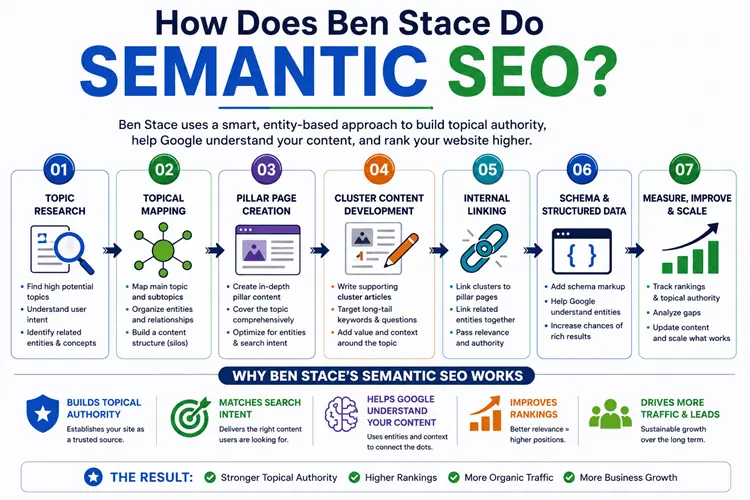
Ben Stace follows a clear and organized SEO process instead of making decisions based on assumptions. His strategy is built around research, planning, and a structured workflow that can be repeated for different websites and topics.

The process starts by finding the main keyword along with related topics, entities, and search terms connected to the subject. After collecting this information, he creates a content plan that shows how each topic is linked. He then develops a detailed pillar page and supports it with several related articles that connect through internal links. This structure helps search engines understand the topic better while improving the website’s overall authority.


Step 1: Topic Research and Entity Mapping

The first step in Ben Stace’s process is to understand the topic from every important angle before creating any content. Instead of jumping straight into writing, he gathers information about related concepts, common user questions, supporting topics, and important entities connected to the main subject.

This research helps him build a clear content plan that shows how every idea fits together. By organizing the topic in advance, he creates a strong foundation that makes the content more complete, relevant, and easier for search engines to understand.

Step 2: Create a Detailed Pillar Page

After completing the research, Ben Stace develops a detailed pillar page that explains the main topic in one place. This page acts as the central resource and provides a broad overview while linking to other articles that explore individual sections in greater detail.

Step 3: Write Supporting Cluster Content

The next step is to publish separate articles for each important subtopic discovered during the research phase. These supporting pages cover specific subjects in depth and are connected to the main pillar page through internal links. Together, they create a well-organized content structure around the topic.

Step 4: Focus on User Search Intent

Before creating any page, Ben considers what the visitor is actually looking for. He identifies the purpose behind the search and chooses the most suitable content format, whether it is a detailed guide, a frequently asked questions page, a comparison article, or another helpful resource.

Step 5: Use Related Keywords Naturally

Instead of repeating the same keyword many times, Ben includes related terms, similar phrases, and relevant entities throughout the content. Everything is written in a natural way so the article remains easy to read while giving search engines better context about the topic.

Step 6: Build a Strong Internal Linking Structure

The final step is to connect all related pages with meaningful internal links. The pillar page links to every supporting article, and each supporting article links back to the pillar page where appropriate. This organized linking structure helps visitors navigate the website and allows search engines to understand the relationship between all the content.

How Ben Stace Strengthens Topical Authority with Semantic SEO?

Building topical authority is one of the main goals of Ben Stace’s SEO strategy. Instead of publishing unrelated articles, he creates content that focuses on one subject from multiple perspectives. This organized approach helps search engines recognize a website as a reliable source of information.

Rather than relying on keyword repetition, Ben develops groups of related articles that are connected through internal links. Each article explores a different part of the topic, and together they create a complete knowledge hub that supports the main subject.

For example, if a website only publishes one article about running shoes, it covers a limited area. However, if it also includes content about shoe types, running techniques, injury prevention, maintenance tips, and training advice, the website provides much broader coverage. This signals to Google that the site has strong expertise on the topic.

Ben Stace often explains that creating topical authority starts with careful planning. He researches related entities, important subtopics, and common user questions before building a content strategy that covers the subject in a logical way.

His semantic SEO framework is based on three key principles:

  • Complete Topic Coverage: Create content that answers different aspects of a subject instead of targeting only a few keywords.
  • Strong Semantic Connections: Keep every article closely related to the main topic so search engines clearly understand the relationship between pages.
  • Regular Content Growth: Continue publishing useful content within the same topic area to strengthen authority over time.

This strategy shows that understanding user intent and building meaningful content relationships can be more valuable than simply increasing keyword usage. Although earning topical authority takes time, a well-structured content strategy can create long-term rankings that are much harder for competitors to replace.

Entity Optimization: The Foundation of Semantic SEO

Entity optimization is one of the most important parts of modern SEO because it helps search engines understand the real meaning behind your content instead of only matching keywords.

Search engines use advanced language processing to recognize different entities, such as people, businesses, products, locations, organizations, and ideas. They also study how these entities are connected. When your content clearly explains these relationships, it becomes easier for search engines to understand your page and show it for relevant searches.

An entity is anything with a clear identity. It can be a brand, a person, a product, a place, or even a specific topic. Search engines organize these entities and their connections to better understand information across the web.

Rather than focusing only on exact keywords, semantic SEO is based on creating content around complete topics, user intent, and related questions. This approach helps search engines recognize the main subject of your page and understand how each section supports the overall topic. Strong context and clear connections between ideas make your content more valuable and easier to interpret.

Simple Ways to Improve Entity Optimization

  • Clearly introduce the main people, brands, products, places, or concepts mentioned in your content.
  • Explain how these entities relate to one another so the topic is easy to understand.
  • Add structured data (schema markup) to provide search engines with clear information about your page.
  • Connect related pages on your website using internal links to strengthen topical relevance.
  • Mention trusted and well-known sources or organizations where appropriate to improve context and credibility.

Schema markup gives search engines extra details about your content in a structured format. It helps them identify the main topic, understand important entities, and connect your page with related information across the web. This can improve your chances of appearing in enhanced search features, such as rich results and AI-powered search experiences.

When entity optimization is done correctly, your content becomes more understandable, better organized, and more relevant. As a result, search engines can confidently match your pages with the right search queries, increasing the opportunity for stronger rankings and long-term organic visibility.

Internal Linking: A Key Part of Semantic SEO

Internal linking is much more than connecting one page to another. It is an important SEO strategy that helps search engines understand how all the pages on your website are related. A well-planned internal linking structure creates a clear path for both users and search engines to explore your content.

A strong internal linking system offers several benefits:

  • It helps search engines discover the relationship between different pages.
  • It transfers authority from high-performing pages to newer or less visible pages.
  • It improves your website’s topical coverage by connecting related content.
  • It encourages visitors to explore more pages, increasing engagement and time spent on your website.

Best Practices for Internal Linking

Connect supporting pages to the main guide.

If you have multiple articles covering different parts of one topic, each supporting article should link back to the main pillar page. This helps search engines recognize the pillar page as the primary source of information.

Link the pillar page to all related articles.

The main page should also include links to every supporting article. This allows visitors to explore the topic in greater detail while helping search engines understand your content structure.

Link closely related articles together.

Whenever two articles discuss similar subjects, connect them with internal links. This strengthens topical relevance and makes your website easier to navigate.

Use meaningful anchor text.

Instead of using generic phrases like “Click Here” or “Read More,” choose descriptive anchor text that clearly explains what users will find after clicking the link. This provides better context for both readers and search engines.

When internal linking is organized correctly, your website becomes a well-structured knowledge hub instead of a collection of separate pages. This improves content discoverability, strengthens topical authority, enhances the user experience, and helps search engines understand your website more effectively.

Semantic SEO Writing Tool and How It Works

A semantic SEO writing tool is designed to make content creation easier by helping writers produce complete, well-structured, and search-friendly articles. Instead of relying only on keywords, it focuses on covering a topic in depth so search engines can better understand the content.

The tool reviews your article before publication and provides useful suggestions to improve its overall quality and relevance. This helps create content that is more informative for readers and more understandable for search engines.

Common Features of a Semantic SEO Writing Tool

  • Entity Detection: Identifies important people, brands, products, places, and other key topics that should be included in your content.
  • Topic Coverage Analysis: Checks whether your article explains the subject completely or if important information is missing.
  • Search Intent Evaluation: Reviews your content to ensure it matches what users are actually searching for.
  • Internal Link Suggestions: Recommends relevant pages from your website that can be linked naturally to improve navigation and topical relevance.
  • Content Gap Analysis: Highlights missing subtopics or questions that similar high-ranking pages have already covered.

By automating these checks, the tool helps writers follow a consistent content strategy across an entire website. It reduces manual work while improving content quality and organization.

For businesses and publishers that regularly produce large amounts of content, using a semantic SEO writing tool can improve efficiency, strengthen topical authority, and increase the chances of achieving better organic search rankings over time.

Entity Optimization: A Smart Approach to Semantic SEO

Entity optimization is one of the most important techniques in semantic SEO because it helps search engines understand the real meaning of your content instead of simply matching keywords. When your content clearly explains topics and their connections, search engines can interpret it more accurately and display it for relevant searches.

Search engines use advanced language processing to identify different entities, such as people, brands, products, places, organizations, and ideas. They also examine how these entities are connected to each other. The clearer these relationships are, the easier it becomes for search engines to understand the purpose of your content.

An entity is any unique and identifiable item. It could be a company, person, location, product, service, event, or concept. Modern search engines organize information by connecting these entities, allowing them to better understand topics across the web.

Instead of focusing only on exact keywords, semantic SEO emphasizes complete topic coverage, user intent, and contextual relevance. This means creating content that answers related questions, explains important concepts, and naturally connects supporting information. A well-structured article gives search engines a better understanding of the topic as a whole.

Best Practices for Entity Optimization

  • Clearly introduce and explain the main people, brands, products, places, or concepts discussed in your content.
  • Describe how these entities are related so the topic is easier to understand.
  • Add schema markup to provide structured information about your page and its key entities.
  • Use internal links to connect related articles and strengthen topical relevance across your website.
  • Mention trusted and authoritative sources or organizations where appropriate to improve credibility and context.

Schema markup acts as structured information that helps search engines identify the purpose of your page more accurately. It provides clear signals about the main topic and its important entities, making it easier for search engines to connect your content with relevant search queries and advanced search features.

When entity optimization is implemented correctly, your content becomes more organized, informative, and easier for search engines to understand. This improves topical authority, increases visibility in search results, and supports stronger long-term SEO performance.

How Ben Stace Applies Internal Linking in Semantic SEO?

In Ben Stace’s semantic SEO approach, internal linking is not something added at the end of the content process. It is a planned part of website structure that helps organize information and create stronger connections between related pages.

His method uses research, content relationships, and contextual links to build a website structure that search engines can easily understand. Instead of having separate pages with no connection, he creates a connected information system where each page supports the others.

Internal linking plays an important role in semantic SEO because it:

  • Helps Google understand the connection between different pages on a website
  • Shares authority from high-performing pages to other important content
  • Shows search engines the complete depth of a website’s topic coverage
  • Encourages visitors to explore more pages and spend additional time on the site

Ben Stace follows a structured internal linking process:

Cluster Pages Link to the Main Pillar Page:

Supporting articles connect back to the main topic page. This helps strengthen the pillar content and improves its ability to rank for wider search terms.

The Pillar Page Connects to Supporting Articles:

The main page links to detailed cluster content, helping spread relevance and authority throughout the entire topic group.

Related Cluster Pages Link Together:

When two supporting articles discuss connected ideas, they link to each other. This creates a strong network of related information that improves content understanding for both users and search engines.

Use Clear and Relevant Anchor Text:

Instead of using generic phrases like “click here,” Ben focuses on descriptive anchor text that explains what the linked page covers. This gives Google better context about the relationship between pages.

The final result is a well-connected website where content works together as a complete knowledge system rather than existing as separate, unrelated articles.

Semantic SEO Writing Tool and Its Benefits

A semantic SEO writing tool helps content creators produce well-structured, informative, and search-friendly articles more efficiently. Instead of focusing only on keywords, it analyzes the overall topic and ensures that every important aspect is covered. This makes the writing process easier while improving the quality of the final content.

The tool evaluates your article before publication and provides recommendations that help create content with better topical depth, stronger relevance, and improved search engine understanding.

Main Features of a Semantic SEO Writing Tool

  • Entity Analysis: Detects important entities such as people, brands, products, locations, and related terms that should be included in your content.
  • Topic Coverage Check: Reviews whether your article fully explains the subject or if essential information is missing.
  • Search Intent Review: Ensures your content answers the questions and needs that users are searching for.
  • Internal Linking Suggestions: Recommends relevant pages on your website that can be linked naturally to strengthen your content structure.
  • Content Gap Detection: Compares your article with well-performing content and highlights missing topics, sections, or important details.

By automating these tasks, the tool helps writers maintain a consistent content strategy across an entire website. It saves time, improves organization, and reduces the chances of overlooking important information during the writing process.

For businesses, publishers, and digital marketers who create content regularly, using a semantic SEO writing tool can improve productivity, build stronger topical authority, and increase the likelihood of achieving better rankings in organic search results.

Benefits of Using a Semantic SEO Strategy

One of the biggest advantages of semantic SEO is that it focuses on building long-term topical authority instead of chasing individual keywords. By creating content that fully explains a subject and answers user intent, websites can achieve more stable and sustainable search visibility.

As search engines become better at understanding context and meaning, websites that organize their content around complete topics often perform better than those relying only on keyword repetition. A strong semantic SEO strategy helps search engines recognize your expertise, making it easier to rank for a wider range of related search queries.

Common Results of a Strong Semantic SEO Strategy

  • Higher organic traffic as search engines better understand your content.
  • Improved rankings for multiple related keywords instead of a single search term.
  • Better visibility for local businesses through optimized FAQs, structured data, and topic-focused content.
  • Stronger topical authority by organizing articles into well-connected content clusters.
  • Long-term ranking stability because the content is built around user intent and comprehensive topic coverage.

A successful semantic SEO strategy creates a clear relationship between your pages, strengthens internal linking, and covers topics in depth. Over time, this helps search engines trust your website as a valuable source of information.

Rather than focusing only on keyword density, semantic SEO emphasizes context, relevance, and content quality. This approach supports lasting organic growth, improves user experience, and increases the chances of maintaining strong search rankings as search algorithms continue to evolve.

How Prime Future AI Uses Semantic SEO for USA Businesses?

At Prime Future AI, we help USA businesses improve their online visibility by using a semantic SEO strategy that focuses on building strong topical authority. Instead of targeting only individual keywords, we create a complete content structure that helps search engines understand your website and its expertise.

Our goal is to develop high-quality, well-connected content that matches user intent and supports long-term organic growth.

Our Semantic SEO Services

  • Create a complete topical map before developing any content.
  • Build detailed pillar pages that cover your main business topics.
  • Write supporting cluster articles that improve topical relevance and answer related user questions.
  • Add schema markup and structured data to help search engines understand important pages.
  • Improve internal linking so related pages are connected naturally across your website.
  • Perform content gap analysis to discover missing topics and new content opportunities.
  • Monitor keyword performance, topical authority, and organic growth through regular reporting.
  • Strengthen the technical SEO foundation to support better crawling, indexing, and overall website performance.

Our approach is centered on creating valuable content that demonstrates expertise and builds trust with both users and search engines. By developing a strong topical structure, businesses can improve search visibility, attract qualified visitors, and achieve steady long-term growth.

If you want to strengthen your website with a semantic SEO strategy and increase your organic traffic, Prime Future AI can help you build a content foundation designed for lasting success.